Enterprise AI: A Complete Guide to Strategy, Use Cases and Implementation
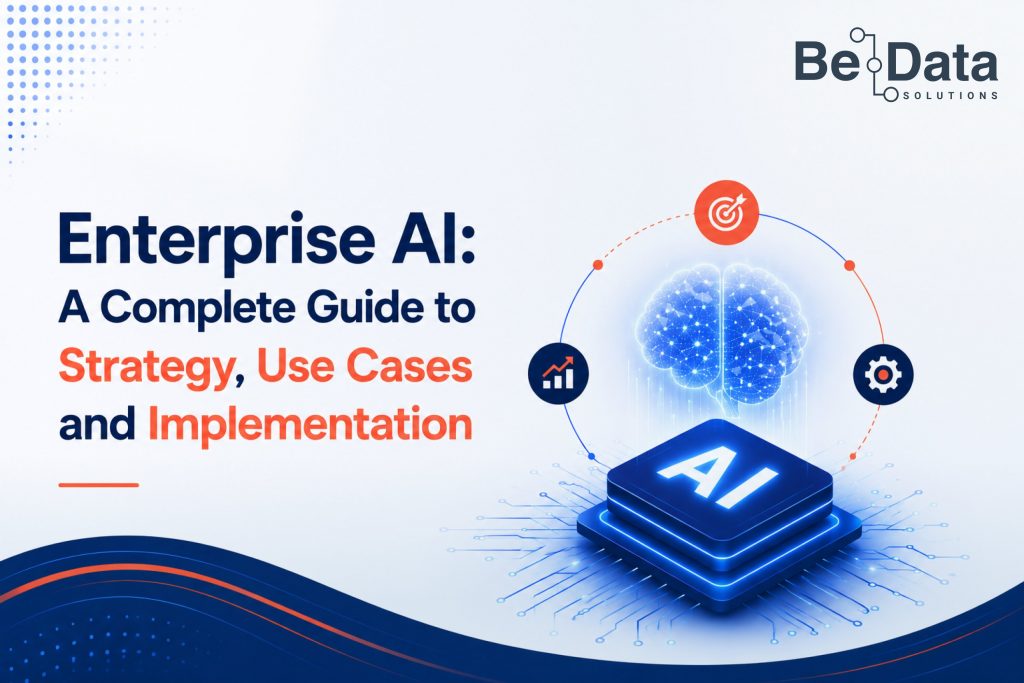
Enterprise AI: A Complete Guide to Strategy, Use Cases and Implementation
Organisations across industries are spending more on AI than ever before. Budgets are growing. Executive mandates are in place. Proof-of-concept projects are running in almost every major business function.
And yet — most enterprise AI investments are not delivering the returns that justified them.
That’s not an AI problem. It’s a strategy and implementation problem. The technology works. What doesn’t work is treating AI as a software purchase rather than a capability that has to be built, governed, and integrated thoughtfully across the business.
This guide covers everything you need to know — from what enterprise AI actually means in practice, to where it creates the most value, to how to implement it without stalling in the pilot phase indefinitely.
What Enterprise AI Actually Means
Enterprise AI is the integration of artificial intelligence technologies — machine learning, natural language processing, generative AI, and automation — into the core workflows of an organisation at scale.
The critical distinction is the word at scale. A developer using an AI coding assistant is not enterprise AI. Enterprise AI is when that same organisation deploys AI across its data pipelines, customer operations, finance function, and engineering teams — with shared governance, integrated data infrastructure, and consistent quality controls across all of it.
The core technologies that make up an enterprise AI stack:
- Machine learning (ML): Systems that learn from historical data, identify patterns, and improve their outputs over time without being explicitly reprogrammed
- Natural language processing (NLP): AI that reads, interprets, and generates human language — the engine behind intelligent search, document processing, and conversational tools
- Generative AI and large language models (LLMs): AI that creates content, writes code, answers complex questions, and reasons through unstructured problems
- Agentic AI: AI that doesn’t just respond to prompts — it takes autonomous actions across connected systems based on defined goals
- Computer vision: AI that interprets images, video feeds, and visual data for quality control, security, and operational monitoring
- Predictive analytics: AI that surfaces forward-looking insights from structured business data — demand forecasting, churn prediction, risk modelling
Enterprise AI combines these technologies into an integrated capability — not a collection of disconnected tools.
Why the Business Case Is Stronger Than Ever
The commercial argument for enterprise AI has sharpened considerably. Organisations that implement AI with a structured, strategy-led approach report dramatically better outcomes than those treating it as an ad hoc technology initiative.
What the data consistently shows:
- Companies with a clear AI strategy achieve success rates roughly double those without one
- AI-powered customer support operations are cutting service costs by 20–30% without reducing quality
- Predictive maintenance systems in manufacturing and infrastructure are reducing unplanned downtime by double digits
- Data teams using AI-assisted analytics are delivering insights in hours that previously took days
The competitive pressure is also real. The majority of large organisations now have AI deployed in some form across multiple departments. For businesses still in the evaluation phase, the gap in operational capability is already widening. The window for gaining a meaningful first-mover advantage in most sectors is narrowing.
Enterprise AI Use Cases by Business Function
| Business Function | High-Impact Use Cases | Business Outcome |
| Data & Analytics | Automated data pipelines, AI-assisted insight generation, anomaly detection | Faster decisions, reduced analyst bottlenecks |
| Customer Operations | Intelligent chatbots, AI copilots for agents, sentiment analysis | Lower support costs, higher CSAT scores |
| Sales & Marketing | Lead scoring, personalisation at scale, automated CRM updates | Higher conversion rates, shorter sales cycles |
| Finance | Invoice processing, fraud detection, spend forecasting | Reduced manual processing, improved risk management |
| HR & Talent | CV screening, onboarding automation, attrition prediction | Faster hiring cycles, reduced churn |
| Engineering & IT | AI-assisted development, automated testing, incident prediction | Faster delivery, fewer production incidents |
| Supply Chain | Demand forecasting, inventory optimisation, supplier risk monitoring | Lower inventory costs, improved resilience |
| Legal & Compliance | Contract review, regulatory monitoring, policy Q&A | Reduced review time, lower compliance risk |
The highest-value implementations tend to be those where AI is applied to high-frequency, data-rich workflows — not one-off tasks or low-volume processes.
The Five Components Every Enterprise AI System Needs
A working enterprise AI system is not a model you plug into your existing infrastructure and switch on. It’s a stack of interconnected components that all need to function well together. Weakness in any single layer limits the entire system.
1. Data Infrastructure AI is only as good as the data feeding it. That means clean, accessible, well-governed data stored in formats your AI systems can actually use — not siloed across legacy databases and inconsistent formats. This is the component most organisations underinvest in, and the most common reason AI projects fail to scale.
2. The AI and ML Layer The models themselves — whether pre-trained foundation models, fine-tuned LLMs, or custom-built ML systems designed for a specific business problem. Choosing the right architecture for the use case matters considerably more than choosing the most powerful or well-publicised model.
3. Integration and APIs Your AI layer needs to connect to the systems your business actually runs on — your CRM, ERP, ITSM, HRIS, and data warehouses. Without robust integration, AI works in isolation and delivers a fraction of its potential value.
4. Governance and Security Enterprise AI requires rigorous controls that consumer tools don’t. Who accesses what data? How are models monitored for performance drift and bias? What happens when an AI output is wrong? Governance isn’t a compliance checkbox — it’s what makes AI trustworthy enough to rely on at scale.
5. Interface and Workflow Layer The interface your people actually use. AI that’s difficult to access or that sits outside existing workflows doesn’t get used. The best enterprise AI implementations embed into how people already work, so adoption happens organically rather than through mandate.
The Biggest Reasons Enterprise AI Implementations Fail
Most enterprise AI failures share a common set of root causes. Understanding them is half the work of avoiding them.
- Treating data as an afterthought. Building models before the data infrastructure can support them produces impressive demos and unreliable production systems.
- Starting too broad. Organisations that try to transform multiple functions simultaneously almost always lose focus, coherence, and the ability to measure what’s working.
- Skipping governance until something goes wrong. AI governance frameworks that are retrofitted after a problem surfaces are always more expensive than ones built in from the start.
- Underestimating the change management challenge. The technology is often the easier part. Getting teams to trust, adopt, and work alongside AI is the harder and more important work.
- Measuring outputs instead of outcomes. Tracking model accuracy without measuring business impact is the enterprise AI equivalent of optimising click-through rates without measuring revenue.
How to Build an Enterprise AI Strategy That Actually Works
A strategy that delivers starts with three questions most organisations don’t ask clearly enough before they begin.
What specific business problem are we solving? Not “we want to be more AI-driven” — but what operational bottleneck, what cost centre, what customer experience gap does this AI initiative exist to address? Precision here determines everything that follows.
What data do we have, and is it good enough? An honest audit of your current data assets — their quality, coverage, accessibility, and relevance to the intended use case — before any model development begins. This step is consistently skipped, consistently regretted.
How will we measure success? Not model metrics, but business outcomes. What does success look like at 90 days, six months, and 12 months — in terms that a CFO or COO would recognise as meaningful?
Once those three questions have honest answers, the implementation phases follow a logical structure: focused pilot in a high-value, well-defined use case → measure against defined outcomes → iterate and refine → scale to adjacent functions with the model proven.
The trap is skipping the pilot discipline and attempting scale first.
Why Be Data Solutions for Enterprise AI
There is no shortage of organisations offering AI services. What’s significantly rarer is a partner with genuine technical depth across the full enterprise AI stack — and the commercial honesty to tell you what AI can and cannot do for your specific situation before a contract is signed.
Here’s what working with Be Data Solutions looks like in practice:
- Senior-led engagements throughout. The technical specialists who scope your project are the ones delivering it — not handed off after the initial conversation.
- Full-stack capability. Data engineering, ML model development, MLOps, cloud infrastructure, analytics, and software engineering — all in one place. No subcontracting the parts that require specialist knowledge.
- Data-first methodology. Every AI engagement starts with a data audit. The quality of your AI output is a direct function of your data quality, and we won’t skip that step regardless of timeline pressure.
- Domain experience across sectors. Our work spans financial services, retail, logistics, healthcare, and professional services — which means we bring relevant pattern recognition to your use case, not just general AI capability.
- Governance built in from the start. We design AI governance frameworks into every engagement architecture — not as a retrofit when something goes wrong.
- Honest commercial conversations. We tell clients what AI can realistically deliver for their specific data, their specific timeline, and their specific budget. That honesty produces better outcomes and longer client relationships.
Getting Started Without Getting Stuck
The most damaging version of enterprise AI isn’t a failed project — it’s a permanently stalled pilot. Organisations that run the same proof of concept for 18 months, never quite ready to move to production, are consuming budget and organisational patience without building capability.
The antidote is starting narrow, defining success before you begin, and treating the first implementation as a learning system — not a finished product.
Pick one function. One use case. One team willing to work alongside the implementation and give honest feedback. Get it to production. Measure it. Then expand with the evidence that the model works.
That sequence isn’t slow. It’s the fastest reliable path from AI investment to AI value.
Ready to build enterprise AI that actually performs in production? At Be Data Solutions, we work with organisations at every stage — from initial strategy and data readiness assessments through to full-scale AI deployment and ongoing support. Let’s have a direct conversation about where you are and what the right next step looks like.