
Staff Augmentation Best Practices: How to Scale Your Tech Team Without Losing Control
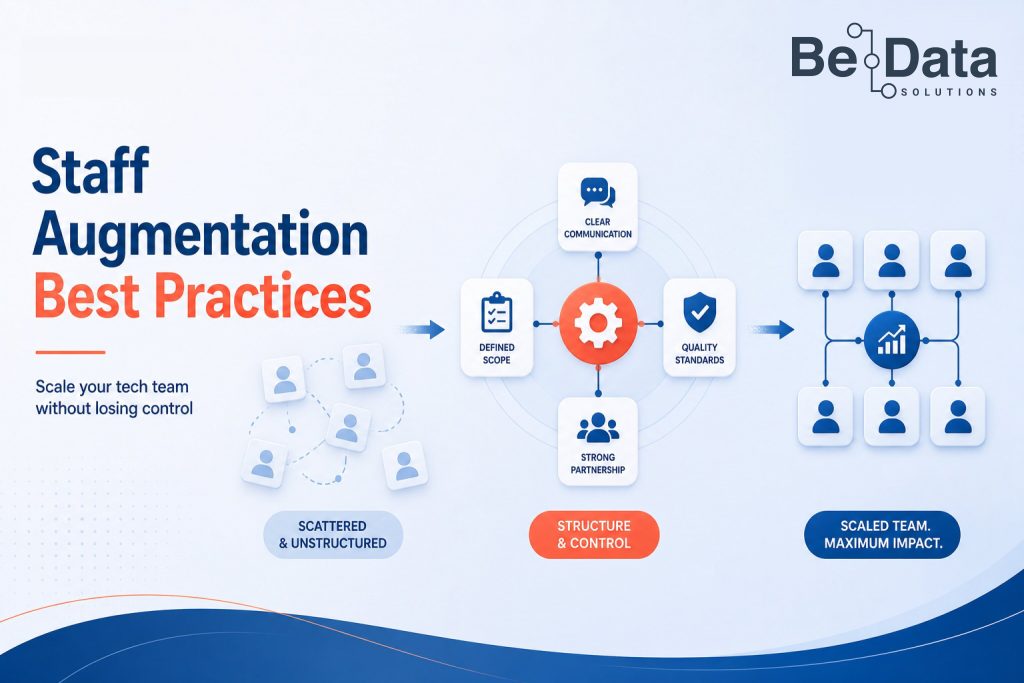
Scaling a technical team under pressure is one of those challenges that looks straightforward until you’re in the middle of it.
You have a project deadline that won’t move. Your internal team is already stretched. Hiring full-time takes three months minimum — if you’re lucky — and the role you need filled might only be relevant for the next six. So you explore staff augmentation. You bring in external engineers, specialists, or analysts to fill the gap.
And then, somewhere between the contract signing and the first delivery, things quietly start to unravel. Communication gets patchy. Quality is inconsistent. Your internal team isn’t sure what the augmented staff are actually working on. You’re spending more time managing the arrangement than benefiting from it.
Sound familiar? It shouldn’t have to go that way. Staff augmentation, done with genuine discipline, is one of the most effective tools available to growing technology organisations. The difference between the version that works and the version that doesn’t usually comes down to a handful of practices that are easy to skip when you’re moving fast.
Here’s what those practices actually look like.
Start With Clarity — Not Headcount
The most common mistake organisations make when entering a staff augmentation arrangement is defining the need as a number. “We need two backend developers” or “We need a data engineer for six months.” That’s a headcount request, not a scope definition — and there’s a meaningful difference.
Before you talk to any provider, the work that needs doing should be clearly mapped. What specific deliverables are expected? What does success look like at 30, 60, and 90 days? What decisions will this person or team need to make independently, and which ones require internal sign-off? What does the existing codebase, data infrastructure, or architecture look like, and what skills are actually required to work within it?
The sharper that picture is before the engagement starts, the better every subsequent decision becomes — from selecting the right talent profile to structuring the onboarding process to evaluating whether the arrangement is delivering value.
Ambiguous briefs produce expensive mismatches. An experienced augmentation partner will push back on vague requirements. If yours doesn’t, that’s worth noticing early.
Treat Onboarding Like It Matters — Because It Does
There’s a tempting assumption that augmented staff, being experienced professionals, can hit the ground running with minimal hand-holding. In practice, that assumption costs time and money consistently.
External team members, regardless of how skilled they are, don’t arrive with context. They don’t know your tech stack’s particular quirks. They don’t know which legacy components are load-bearing and which are scheduled for deprecation. They don’t know the unwritten conventions your internal team has developed over years of working together. And they don’t know who to ask when they’re unsure about something.
A structured onboarding process — even a condensed one — closes these gaps faster than leaving people to figure it out as they go. That means documented access to architecture decisions and existing systems, introductions to the internal team members they’ll work alongside most, a clear picture of the communication channels and tools the team uses, and explicit clarity on what good output looks like in your specific context.
Teams that invest two or three days in proper onboarding typically recover that time within the first two weeks. Teams that skip it spend months making up for early misalignment.
Communication Structure Isn’t Optional
When augmented staff work remotely — which is now the norm across the industry — the communication infrastructure around the engagement is what determines whether it functions as a real team or a loose arrangement of individuals.
A few things matter here more than most teams anticipate.
The augmented team members should be integrated into the same communication tools and rhythms as your internal team, not siloed into a separate workflow. If your internal engineers use Slack, are on the same channels, and attend the same standups, external engineers should too. Parallel structures create parallel accountability, which is another way of saying accountability for nobody.
Regular structured checkpoints — not just ad hoc catch-ups when something goes wrong — matter a lot. Weekly syncs that review progress against defined milestones, surface blockers early, and give both sides the opportunity to recalibrate before small issues become large ones.
And one role that’s worth explicitly assigning: a single internal point of contact who owns the relationship with the augmented team. Not as a gatekeeper, but as someone who can provide context, prioritise competing demands, and maintain continuity when things get complex. Distributed ownership of an external team relationship usually means no one owns it.
Define Quality Standards Upfront — Then Enforce Them
This is the area where augmentation arrangements most often erode quietly. The engagement starts well. The early output looks reasonable. Delivery pressure builds. Reviews get rushed. Standards drift. Six months later, you have a codebase, a dataset, or a system that your internal team doesn’t fully trust — and fixing it costs more than the augmentation arrangement saved.
The antidote is treating quality standards as a structural part of the engagement, not a guideline. That means code review expectations are defined and followed — not compressed when a deadline is close. It means test coverage requirements are agreed upon at the start. It means data quality checks, documentation standards, and architectural conventions are written down and applied consistently.
None of this is particularly complicated. What it requires is the discipline to prioritise it when the easier option is to move faster and clean it up later. In technology, “clean it up later” rarely happens on the schedule you intend.
Align Legal and IP Considerations Before Work Begins
This one sometimes feels bureaucratic until it isn’t. In an augmentation arrangement, external team members are often writing code, building models, or designing systems that will live in your production environment. The question of who owns that work, how confidential information is protected, and what happens to deliverables when the engagement ends should be resolved in contracts before anyone writes a line of code.
For organisations operating in regulated industries — financial services, healthcare, or the public sector — this is non-negotiable. But even outside those contexts, unclear IP arrangements create complications that are far easier to avoid than resolve after the fact. A reputable augmentation partner will have standard provisions for this and should be comfortable discussing them directly.
Measure the Right Things
Engagement success should be measured against outcomes, not outputs. The number of tickets closed, lines of code written, or hours logged are activity metrics. They tell you the team was busy. They don’t tell you whether the engagement is delivering value.
The better questions: Is the project progressing against the milestones that were defined at the start? Is the augmented team’s work integrating cleanly with internal systems? Is technical debt going up or down? Is the internal team’s capacity genuinely being relieved, or are they spending as much time managing the augmentation arrangement as they’re saving?
Reviewing these questions at regular intervals — not just at the end of the engagement — gives you the ability to course correct while there’s still time to matter.
Choosing the Right Partner Changes Everything
All of the above assumes a capable partner on the other side of the arrangement. Selecting that partner deserves more rigour than it typically receives.
The most important signals to evaluate aren’t marketing claims — they’re evidence of how the provider operates in practice. Do they push back on poorly defined requirements, or do they just say yes and send a CV? Do they have a track record in your specific domain — data engineering, software engineering, AI, analytics? Do they offer transparency into how they source, vet, and manage their talent? And are they willing to commit to the kind of structured accountability described above, or do they prefer arrangements where accountability is diffuse?
At Be Data Solutions, our model is built around exactly this kind of engagement — senior UK-based leadership working alongside a highly skilled global delivery team, with the technical depth to deliver across data engineering, software engineering, analytics, and AI. We’ve built our practice around the idea that the best augmentation arrangements function as genuine extensions of a client’s team, not as an external vendor relationship that requires constant management overhead.
The difference in how you structure that relationship from day one is where the real value is made or lost.
Thinking about augmenting your technical team? Whether you need data engineers, software developers, or AI specialists — let’s have a straightforward conversation about what your project needs and how we can support it. Get in touch with the Be Data Solutions team.