Hire Offshore AI Engineers in 2026: What Smart Companies Are Doing Differently
Picture this: your competitor just shipped an AI feature that cut their customer churn by 30%. Your board is asking why you haven’t done the same. Your senior engineers are stretched thin, recruiting timelines are dragging into months, and every AI specialist you interview has three competing offers on the table.
This is the reality for hundreds of companies right now — not a future scenario, but today’s Tuesday morning problem. The global AI talent crunch is real, it’s worsening, and waiting it out is not a strategy.
The companies pulling ahead aren’t necessarily the ones with the biggest hiring budgets. They’re the ones who figured out that world-class AI engineering talent exists far beyond Silicon Valley or London — and learned how to access it without burning months or making expensive hiring mistakes.
That’s exactly what this guide is about. At Be Data Solutions, headquartered in Bangladesh and working with clients across the globe, we’ve helped organizations build offshore AI teams that move fast, deliver real production systems, and integrate cleanly into existing engineering workflows. This is everything we know about doing it right.
Why the Old Rules of Offshore Hiring Don’t Apply to AI
Offshore hiring used to be simple. You needed web developers or QA engineers, you went to an established market, you found people with the right technical certifications, and you hired them.
AI is fundamentally different — and that difference is what trips most companies up.
The demand for AI talent exploded faster than the supply of engineers who actually have it. Hundreds of developers across every market added “machine learning” and “generative AI” to their profiles after completing a few online courses. On a resume, they look identical to engineers who’ve spent years building production ML systems. In practice, the gap is enormous.
A developer who completed a PyTorch tutorial is not an ML engineer. Someone who built a ChatGPT wrapper for a hackathon is not an AI specialist. The offshore AI market in 2026 has serious signal-to-noise problems, and companies that don’t know how to filter for the real thing end up with the wrong hires — and a wasted hiring cycle to show for it.
Understanding this upfront changes how you approach the entire process.
Know Exactly What You’re Hiring Before You Hire Anything
The single most common offshore AI hiring mistake isn’t picking the wrong candidate. It’s not knowing what kind of engineer you actually need before you start looking.
There are three meaningfully different profiles in the AI engineering space, and confusing them is expensive.
Integration engineers work with existing AI services. They connect your product to APIs from OpenAI, Google, Anthropic, or Cohere, and build the application logic around those connections — prompt management, response handling, cost optimization, user experience. For most companies at an early AI adoption stage, this is the right hire. They’re faster to find, more widely available, and can start delivering value quickly.
Machine learning engineers build and train custom models using your proprietary data. They work with training pipelines, evaluation frameworks, feature engineering, and deployment at scale. These engineers are rarer and take longer to find, but they’re the right choice when your data is a genuine competitive asset and a third-party API simply can’t do what you need.
Data + AI engineers are the profile most companies undervalue — and the one Be Data Solutions specializes in. These engineers sit at the intersection of data infrastructure and applied ML. They build the pipelines, feature stores, and governance systems that feed your AI. Without this layer working properly, even the most sophisticated model will fail in production. If you’re scaling a data practice alongside your AI initiatives, this profile is almost certainly what you need most.
Clarifying which of these three you’re hiring for before you post a single job description saves weeks of misdirected effort.
The Skills That Separate Real AI Engineers From Resume Keywords
Python fluency is the minimum baseline. Every credible AI candidate has it. What separates genuinely capable engineers from people who’ve learned to list the right tools:
RAG architecture (Retrieval-Augmented Generation) has become a core production skill. Engineers who understand how to ground large language models in your proprietary data — without expensive full retraining — are building systems that actually stay current and useful. This is no longer an advanced specialization; it’s expected.
Vector databases like Pinecone, Weaviate, and Qdrant have become standard infrastructure for any system involving semantic search, recommendation, or LLM memory. Candidates who haven’t worked with them in production are behind the current baseline.
MLOps tooling — MLflow, Kubeflow, Weights & Biases, cloud-native monitoring — is what separates engineers who can build a model from engineers who can maintain one. Production AI doesn’t run itself. If an engineer hasn’t thought about model drift, retraining triggers, and monitoring pipelines, they’ve never shipped anything that stayed alive in production.
Data pipeline fundamentals — dbt, Airflow, Apache Spark, Kafka — matter far more than most job descriptions acknowledge. AI is only as reliable as the data feeding it. Engineers who understand the full stack from ingestion to inference build systems that don’t silently break.
Beyond technical skills, how someone communicates under ambiguity is worth evaluating deliberately. Do they ask clarifying questions before diving into code? Can they explain a trade-off to a non-technical stakeholder? Strong AI engineers almost always can — it’s one of the more reliable signals of real, deep experience.
Where to Find Legitimate Offshore AI Talent in 2026
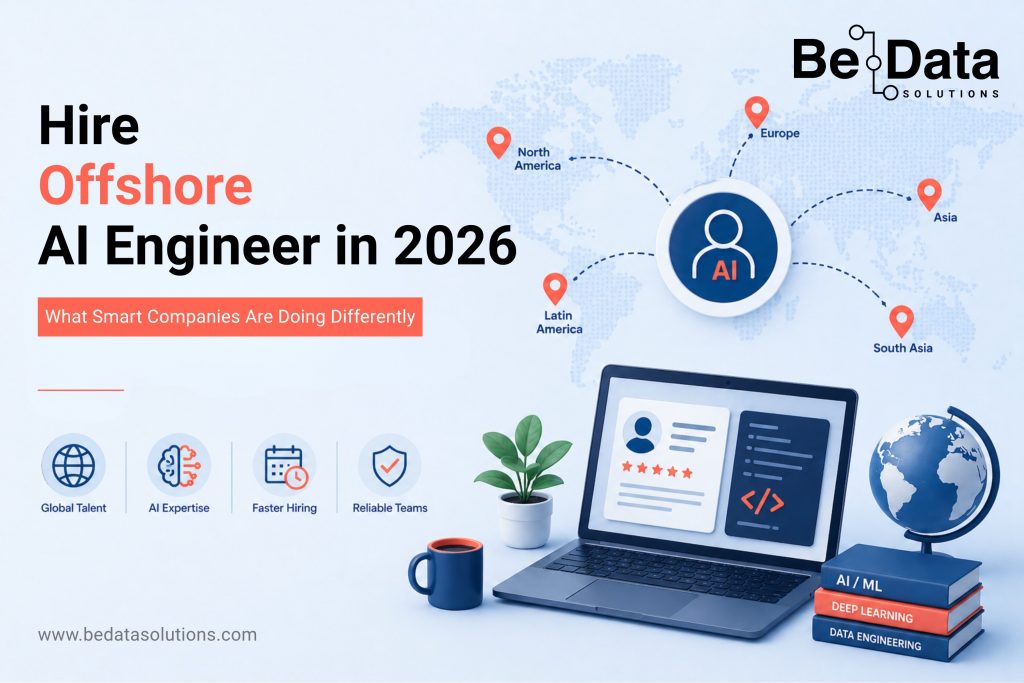
Three regions consistently produce the strongest offshore AI engineering talent. Each has a distinct profile worth understanding.
South and Southeast Asia — including Bangladesh, India, Vietnam, and the Philippines — offers a combination of deep technical talent, strong English communication, and scale no other region can match. Bangladesh in particular has developed a fast-growing AI and data engineering talent pool, with engineers who bring strong mathematical foundations, production experience in ML and data systems, and a genuine understanding of enterprise delivery standards. India has enormous depth in generative AI, LLM fine-tuning, and MLOps. For execution-heavy AI work where asynchronous collaboration works well, Asian teams consistently deliver strong results.
The right region comes down to your timezone priorities, the technical depth your project requires, and your preferred working style. There’s no single correct answer — it’s a trade-off worth thinking through per engagement.
Central and Eastern Europe — particularly Poland, Romania, Ukraine, and the Czech Republic — is the strongest region for technical depth in ML and AI. These countries produce engineers with rigorous mathematics and computer science training, strong English, and business practices that align well with Western clients. Particular strengths include computer vision, NLP, and enterprise-grade ML systems. The timezone gap with US teams is real but manageable with some schedule flexibility.
Latin America — Brazil, Argentina, Colombia, Mexico — is the best choice for US-based companies that need genuine real-time collaboration. The timezone overlap gives 4–8 shared working hours per day, which means live standups, same-day code reviews, and fast feedback loops without anyone working unreasonable hours. Strong capabilities in data science, generative AI, and NLP applications. Cultural alignment with US teams tends to be high.
How to Vet Offshore AI Engineers Without Wasting Months
Resumes and LinkedIn profiles tell you what someone wants you to believe. Here’s a structured process that actually reveals what someone can build:
Start with GitHub, not the CV. Look for original projects — not tutorial notebooks, not cloned repos. You want to see documented decisions, clean commit history, and evidence that something was actually deployed. Engineers who have shipped production AI systems almost always have a GitHub history that reflects it.
Run a skills assessment built around your real problems. Generic coding puzzles reveal almost nothing about AI capability. Give candidates a problem close to what they’ll actually work on. Watch how they approach ambiguity, handle errors, and think about edge cases. The process matters as much as the final answer.
Do a deep-dive on one past project. Ask them to walk you through a production system they built end-to-end. Where did the data come from? How did they handle model drift? What monitoring did they set up? What broke in production and how did they fix it? Engineers who have done this work have specific, detailed answers. Engineers who haven’t give vague, general ones.
Run a paid trial sprint before committing. Give them a real task on your actual project, with your actual data and your actual team. 20–30 days is enough to see how someone thinks, communicates, and delivers under real conditions. Engineers who perform well in the trial almost always deliver strong ongoing work.
Red Flags That Signal AI-Washing Before You Hire
The AI talent market has a growing problem: developers who claim AI expertise without the production depth to justify it. Here’s what to watch for:
They can’t name specific models they’ve worked with or explain why they chose them. Their GitHub has no original AI work — only tutorial forks and starter projects. They talk about model capabilities but can’t articulate how they evaluated performance or handled failure cases. They’ve never deployed anything to a live environment with real users. They’re vague about data handling, access controls, and privacy requirements. The vendor refuses to let you speak directly with engineers before you sign — often because they’re managing a quality gap they’d rather you find after the contract starts.
Any single one of these is worth taking seriously. Multiple at once is a reason to walk away entirely.
How Be Data Solutions Helps With AI Resource Augmentation
Most offshore staffing arrangements work like this: you describe what you need, you get a shortlist of candidates, you hire one, and then you’re largely on your own managing the relationship and hoping the technical fit holds up.
Be Data Solutions works differently.
We’re not a staffing firm. We’re a data and AI practice headquartered in Bangladesh, working with clients across the US, UK, Europe, and the Asia-Pacific region. AI resource augmentation is one of our core services — and we approach it as an integrated capability-building exercise, not a headcount transaction.
Here’s what that looks like in practice:
We define the right profile with you before sourcing anyone. We start by understanding your data infrastructure, your AI maturity, your team structure, and your delivery goals. Most clients come in thinking they need one type of engineer and discover through this conversation that a different profile — or a combination — will get them where they’re going faster and with fewer detours.
We match engineers to your actual stack. Our pool of vetted AI and data engineers across Bangladesh and South Asia brings hands-on production experience in Python, MLOps, RAG systems, NLP, data pipelines, and generative AI applications. We match candidates to the specific tools, cloud platforms, and delivery workflows you use — not just a general category of work.
We stay involved after placement. Our augmented engineers join your team as genuine contributors, following your sprint cadence, using your tools, and participating in your architecture decisions. We provide ongoing support to make sure the engagement stays productive as your requirements evolve — which they always do.
We scale with you. Start with one or two engineers to validate the workflow and build trust. As your AI ambitions grow, we can scale the team around the same integrated model — without you having to rebuild the onboarding and vetting process from scratch each time.
Bangladesh’s growing AI and data engineering ecosystem means our clients get access to talent that combines strong technical foundations, production-grade experience, and a genuine understanding of what enterprise AI delivery actually requires. Many of our clients expect to trade quality for efficiency. With Be Data Solutions, you don’t have to choose between the two.
Ready to extend your AI team with engineers who are matched to your stack and your goals?
Talk to Be Data Solutions today →
IP Protection and Compliance: Sort This Before Anyone Writes Code
This step gets skipped more than any other — and it’s where offshore engagements create the most long-term risk.
Work-for-hire agreements should explicitly state that all IP created during the engagement transfers to your company. Don’t assume it’s implied by the nature of the contract. NDAs should be signed before any technical discussion begins, including during the screening and assessment process. Data handling agreements should specify what data engineers can access, how it must be stored and transmitted, and what happens to it at the end of the engagement. Least-privilege access should be enforced from day one — engineers should only see the systems and data they actively need for their current scope of work.
In 2026, with AI regulations tightening in the EU and UK and enterprise data privacy requirements becoming stricter across the board, vagueness about any of this is not a minor oversight. It’s a disqualifying one.
Frequently Asked Questions
How quickly can I hire an offshore AI engineer?
Through a vetted partner like Be Data Solutions, you can typically receive matched candidate profiles within 48 hours and have an engineer onboarded within 2–6 weeks. Going direct through platforms like LinkedIn or Upwork usually takes 4–10 weeks once you factor in your own vetting effort.
What makes Bangladesh a strong location for offshore AI talent?
Bangladesh has a rapidly growing pool of AI and data engineering professionals with strong mathematics backgrounds, solid production experience, and competitive English communication skills. The country’s technology sector has matured considerably in recent years, and engineers here are working with the same tools, frameworks, and delivery practices as their counterparts in Europe and North America.
What’s the biggest mistake companies make when hiring offshore AI talent?
Skipping real vetting. Resumes in the AI space are especially unreliable right now — many developers list ML tools and frameworks without the production experience to back them up. A structured technical assessment and a paid trial sprint are both non-negotiable if you want to hire confidently.
How do I protect my IP when working with offshore engineers?
Explicit work-for-hire contracts, NDAs before any technical discussion begins, data handling agreements, and least-privilege access controls from day one. Write it all into the contract — never assume it’s implied.
Do I need a deep ML engineer or an integration engineer?
Most companies at an early AI adoption stage need integration engineers first — people who connect existing AI services to your product and build the application logic around them. Custom ML work makes sense once you’ve validated a use case and have proprietary data that justifies the investment.
What does AI resource augmentation actually mean in practice?
It means extending your existing engineering team with offshore AI specialists who integrate into your workflows, contribute to your sprints, and build institutional knowledge about your product — rather than operating as a separate external team. Done well, the distinction between in-house and augmented engineers becomes nearly invisible within a few weeks.
Be Data Solutions is a data and AI practice headquartered in Bangladesh, working with clients across North America, Europe, and the Asia-Pacific region. We specialize in data infrastructure, applied machine learning, and AI resource augmentation — helping organizations build the AI capability they need without the friction of local hiring. Learn more about what we do →