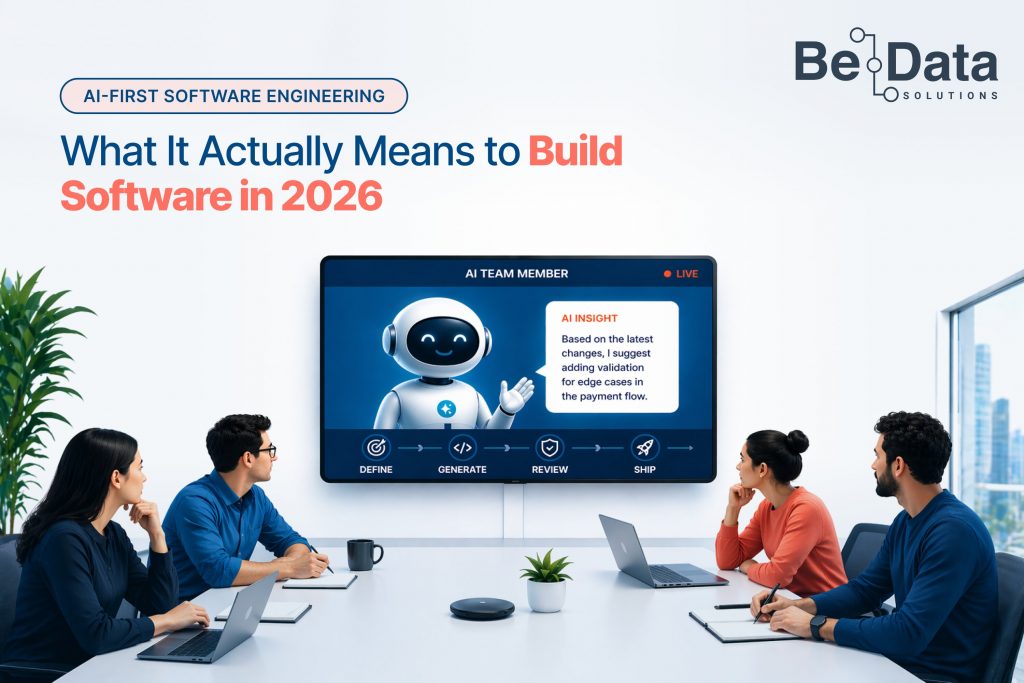
AI-First Software Engineering: What It Actually Means to Build Software in 2026
There’s a phrase that gets thrown around a lot in tech circles right now: “we’re AI-first.”
Usually, it means someone on the team has a Copilot subscription, and there’s a Slack channel called #ai-experiments that gets used twice a month. That’s not AI-first. That’s AI-adjacent. And the gap between those two things is where most software businesses are quietly losing ground.
Real AI-first software engineering is something different — and honestly, it’s more demanding than the marketing version of it. It requires rethinking assumptions that most engineering teams have held for years. Not just what tools you use, but how you structure work, how you define quality, and what you actually expect from your developers day to day.
This piece is about what that shift actually looks like in practice.
The Problem With “Using AI” as a Strategy
When engineering leaders talk about integrating AI into their software process, the conversation usually starts with tooling. Which assistant? Which IDE plugin? Which code review bot?
Those are fine questions. They’re just the wrong starting point.
The deeper issue is that most software delivery processes were built around a specific assumption: that the primary constraint on speed is human throughput. Requirements come in, developers interpret them, write code, hand it to QA, iterate on bugs, and eventually ship. The whole pipeline is calibrated around human cognitive capacity — how much a developer can hold in their head, how long it takes to context-switch, how many review cycles a team can realistically run in a sprint.
AI changes that constraint dramatically. A well-directed AI system can generate, test, and revise code faster than any human team. But if the surrounding process is still designed for human throughput, you’ve created a mismatch. The AI can move faster than the handoffs allow. The bottleneck shifts from writing code to everything else — planning, reviewing, deploying, deciding.
AI-first software engineering starts by acknowledging this mismatch and reorganizing around it.
What “AI-First” Actually Means in Engineering
The simplest way to put it: in an AI-first engineering model, AI is not a tool your developers reach for when they get stuck. It’s a participant in the delivery process from the moment a piece of work is defined to the moment it ships.
That means a few concrete things change.
How work gets defined. Traditional requirements and user stories are written for human readers — they carry implicit context, assume shared understanding, and tolerate some ambiguity because humans can infer their way through it. AI cannot. AI-first engineering requires intent to be written explicitly and precisely, because the AI collaborator acting on it needs clear direction to generate useful output. Vague input produces confident but wrong output. Sloppy requirements are expensive with human developers. With AI, they’re a multiplier on that expense.
How code gets produced. In a conventional workflow, developers write code and then write tests — sometimes. In AI-first engineering, code and tests are generated together. Every unit of business logic comes paired with coverage for expected behavior, edge cases, and regression scenarios. This isn’t optional, and it isn’t extra work slotted in when there’s capacity. It’s the default. The discipline of test-first thinking, which Agile teams have advocated for decades but rarely fully practiced, becomes structurally enforced when AI is doing the generation.
How humans spend their time. This is the part that surprises most developers when they first encounter a genuinely AI-first workflow. Their job changes. Rather than writing the majority of the code themselves, they’re defining intent, reviewing AI-generated output with precision, making architectural decisions, and maintaining quality gates. The cognitive load shifts from production to governance. Many developers find this uncomfortable at first — it feels like less “real” engineering. In practice, it’s more demanding because the stakes of a poor review are higher when AI can generate a lot of code very quickly.
How quality is maintained. In traditional Agile, quality is often a phase — testing happens after development, reviews happen at the end of a sprint, problems surface late. AI-first engineering embeds quality into every step. Human sign-off is required before work moves forward. No phase is skipped because the sprint got tight. The checkpoint is the process, not an interruption to it.
The Skills Gap Nobody Talks About
Here’s something most AI adoption conversations skip past: making a team genuinely AI-first requires capability changes that training alone doesn’t fix overnight.
Developers who thrive in an AI-first model tend to think differently about their role. They’re precise communicators — they write intent documents the way a good lawyer writes a brief, because ambiguity is costly. They’re rigorous reviewers — they treat AI-generated output with healthy skepticism, not passive acceptance. They understand architecture at a level that lets them spot when AI has generated something technically functional but architecturally wrong.
None of that is impossible to develop. But it takes time, and it takes a culture that actively values those skills rather than treating them as optional add-ons to traditional coding ability.
The teams that struggle with AI-first transitions are usually the ones that underinvest in this side of the change. They get the tools, they adopt the workflow, but the human side of the loop stays soft. Reviews are cursory. Intent is written loosely. The AI generates confidently and nobody catches the wrong turns until downstream, when fixing them costs more than it would have to catch them early.
Three Questions to Ask Before Calling Your Team AI-First
If you’re evaluating where your engineering operation actually sits on the AI-first spectrum, these three questions tend to surface honest answers pretty quickly.
First: when a developer starts a new piece of work, how much of the context lives in their head versus in a structured document that an AI collaborator could act on? If the answer is mostly in their head, your process isn’t AI-first yet — it’s AI-assisted at best.
Second: how often does testing get deprioritized under sprint pressure? If the answer is regularly, your quality gates aren’t structural — they’re aspirational. AI-first engineering requires gates that don’t flex under delivery pressure.
Third: what does a code review actually look like on your team? Is it a thorough evaluation of logic, intent alignment, and architectural fit — or is it a sanity check that a colleague runs in fifteen minutes before approving? The review function becomes significantly more important, not less, when AI is generating the code being reviewed.
Why This Is a Business Problem, Not Just an Engineering Problem
Software teams often treat AI adoption as a technical decision. In reality, the choice to become genuinely AI-first has business-level implications.
Teams that make the structural shift — not just the tooling shift — are delivering faster, with fewer late-stage defects and more predictable timelines. The productivity multiplier is real when the process supports it. But teams that bolt AI tools onto an old process typically see modest early gains plateau and then stall, because the surrounding workflow can’t absorb AI’s pace.
For business leaders, this means the ROI question on AI investment isn’t really about which tools to buy. It’s about whether the delivery process has been redesigned to actually use what those tools can do. If it hasn’t, the tools are expensive autocomplete. If it has, the competitive advantage compounds over time.
At Be Data Solutions, this is what we mean when we talk about AI-first engineering — not the tool, but the model. The tool is the easy part. The model is what separates teams that are genuinely accelerating from teams that are mostly talking about it.
Getting Started Without Blowing Up What’s Working
One thing worth saying directly: AI-first engineering doesn’t require a complete overnight overhaul. Most successful transitions start small and prove the model before scaling it.
Pick one team. Pick one project type that’s reasonably well-defined. Redesign how intent is structured for that work. Add paired test generation as a non-negotiable. Tighten the review process. Measure what changes — cycle time, defect rate, rework frequency.
Once the model is proven in a contained environment, expansion is significantly easier. The data makes the case internally, and the team that piloted it becomes the internal guide for the broader rollout.
The trap is waiting for perfect conditions before starting. Those conditions don’t arrive on their own. The teams ahead of you right now didn’t wait for them either.