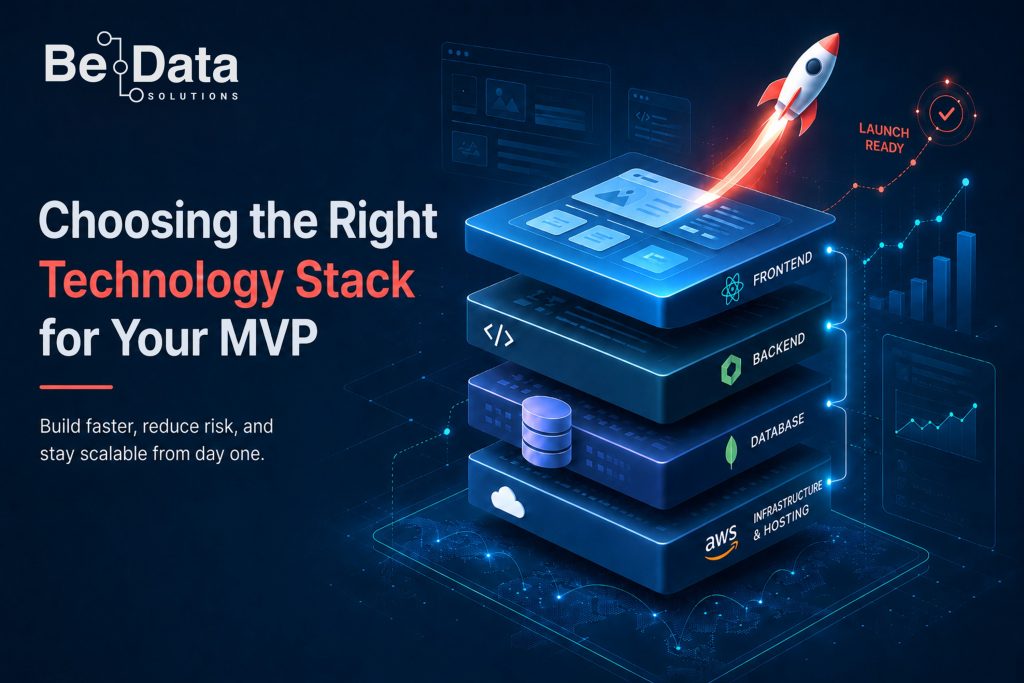
Choosing the Right Technology Stack for Your MVP
For an MVP, the best technology stack is not always the newest or most popular one. It is the stack that helps you launch quickly, test your idea with real users, and improve the product without creating unnecessary technical debt.
A minimum viable product should prove a clear business hypothesis. That means the technology should support speed, reliability, and learning. Over-engineering at the beginning can slow the team down, increase cost, and delay the feedback that matters most.
Start With Three Practical Questions
Before selecting frameworks, databases, or hosting platforms, start with three simple questions: what does your team already know, how fast do you need to launch, and what budget can you realistically support?
Team capability has a direct impact on delivery speed. A familiar language or framework usually beats a theoretically better option that requires weeks of learning. The timeline is equally important because the purpose of an MVP is to reach users early and validate demand. Budget also matters because infrastructure, third-party services, and maintenance costs continue after the first launch.
The right choice is usually the one that balances these three factors. Avoid choosing technology only because it is trending. Choose the stack that helps your product reach the market with confidence.
Understand the Core Layers of an MVP Stack
Most MVPs are built from four core layers: frontend, backend, database, and hosting. Each layer should be selected for simplicity, maintainability, and the ability to support future growth.
| Layer | Main role | Common choices | MVP guidance |
| Frontend | User interface and interactions | React, Next.js, Vue, Svelte | Choose speed, SEO support, and developer availability. |
| Backend | Business logic and APIs | Node.js, Django, Rails, Laravel | Keep it simple and aligned with team skills. |
| Database | Stores product and user data | PostgreSQL, MongoDB | Use PostgreSQL for structured business data; use NoSQL only when flexibility is essential. |
| Hosting | Deployment and runtime | Vercel, Render, Railway, cloud platforms | Prefer managed services for faster launch and easier operations. |
Choose a Frontend That Helps You Ship Faster
For most web-based MVPs, React and Next.js are strong choices because they have a mature ecosystem, wide developer availability, and good support for modern web performance. Next.js is especially useful when SEO, fast page loading, and simple deployment are important.
Vue or Svelte may also work well for smaller teams that value simplicity and speed. The best option depends on the skills already available in your team. A familiar framework with a good component library can save significant design and development effort.
Use proven UI tools such as Tailwind CSS, Material UI, Chakra UI, or similar component systems instead of building every button, form, and layout from scratch. Your MVP should focus on solving the user’s problem, not reinventing common interface elements.
Select the Backend Based on Product Needs
Your backend manages business logic, APIs, user data, workflows, and integrations. Node.js is often a strong fit when the team wants JavaScript across both frontend and backend. Django is useful for data-driven products because it includes many built-in features, including an admin panel and security patterns. Rails and Laravel can also be effective for rapid CRUD-based products and marketplaces.
For most MVPs, REST APIs are enough. They are simple, widely understood, and quick to implement. GraphQL can be introduced later if your product needs multiple client applications, complex data fetching, or more flexible API queries.
Serverless functions can be useful when traffic is low or unpredictable, especially for webhooks, background jobs, and lightweight APIs. A traditional backend may be better when your product requires long-running processes, complex business rules, or real-time connections.
Make a Sensible Database Decision
A database should match the shape of your product data. PostgreSQL is a safe default for SaaS, reporting, multi-tenant applications, transactions, and structured business data. It provides strong data integrity and supports advanced querying when analytics become important.
MongoDB can be useful when the data model changes frequently or when the product is content-heavy with flexible document structures. However, for many business applications, PostgreSQL provides a better long-term foundation because it supports relationships, reporting, and controlled access patterns.
Do not add caching tools such as Redis before there is a real performance need. Many MVPs can operate well without extra infrastructure. Add caching, queues, or search tools when usage patterns clearly justify them.
Be Careful With Mobile Scope
If your product can work well in a browser, a progressive web app may be the fastest and most cost-effective way to test the market. A PWA can serve web and mobile users from a single codebase and can be updated without app store delays.
Choose Flutter or React Native when your MVP truly needs app store distribution, native device features, or a richer mobile experience. Flutter is strong for highly customised interfaces, while React Native can be efficient when the team already works heavily with JavaScript and React.
Use Managed Infrastructure Where Possible
Managed platforms reduce the operational burden on MVP teams. Tools such as Vercel, Render, Railway, Supabase, and major cloud providers can help teams deploy faster without spending too much time on server configuration.
A basic CI/CD setup should be included from the start. Connect source control to deployment, use a staging environment, run essential tests, and keep secrets in environment variables. This does not need to be complex, but it should be reliable enough to support frequent releases.
Monitoring is also essential. Error tracking, uptime checks, response time visibility, and basic product analytics help the team understand what is breaking, what users are doing, and where the product needs improvement.
Do Not Build Everything Yourself
Some services should usually be integrated, not built from scratch. Authentication, payment processing, transactional email, file storage, SMS, and product analytics are good examples. Managed services reduce delivery time and lower security or compliance risk.
For example, using established authentication and payment platforms allows the team to focus on product workflows and customer value. The MVP should prove market demand, not spend weeks rebuilding standard infrastructure.
Avoid Microservices Too Early
Microservices can be powerful at scale, but they are usually unnecessary for an MVP. They add deployment, monitoring, communication, and debugging complexity before the product has enough users to justify it.
A well-structured monolith is often the better starting point. It is easier to build, test, deploy, and maintain. Once the product gains traction and specific bottlenecks appear, selected parts of the system can be separated carefully.
Example MVP Stack Recommendations
For a typical SaaS MVP, a practical stack could include Next.js with Tailwind CSS for the frontend, Node.js or Django for the backend, PostgreSQL for the database, Supabase or Clerk for authentication, Stripe for payments, and Vercel or Render for hosting.
For a data- or AI-enabled MVP, the stack may include a modern web frontend, Python or Node.js services, PostgreSQL, cloud storage, analytics pipelines, and managed AI APIs where appropriate. The goal is to keep the first version focused, measurable, and ready to improve based on real usage.
For a mobile-first MVP, start with a PWA when the core experience works through the browser. Move to Flutter or React Native when the product needs stronger native features or app store presence.
Final Thoughts
The right MVP technology stack should help your team move quickly without blocking future growth. Start with proven tools, use managed services where they make sense, and avoid adding complexity before the product has been validated.
At Be Data Solutions, we help organisations design and build secure software, data platforms, analytics systems, and AI-enabled products that connect technology decisions to measurable business outcomes. A successful MVP is not about using the most impressive stack. It is about launching the right product, learning from users, and scaling with confidence.
Need help planning your MVP technology stack?
Be Data Solutions can help you define the right architecture, delivery roadmap, and engineering approach for secure, scalable software and data-driven products.