AI-Driven Product Engineering: Building Software Products That Scale, Learn, and Deliver Business Value
Product engineering is no longer only about building software. It is about creating digital products that solve real business problems, adapt to user behaviour, and continue improving after launch.
Today, businesses are under pressure to move faster, reduce operational inefficiency, modernise legacy systems, and make better use of data and AI. A product that simply “works” is no longer enough. It must be secure, scalable, measurable, user-friendly, and ready to evolve.
That is where product engineering becomes critical.
At Be Data Solutions, we see product engineering as the connection between software engineering, data engineering, analytics, cloud infrastructure, and practical AI. It brings strategy, design, development, testing, deployment, and continuous improvement into one joined-up delivery model.
This guide explains what product engineering means, how the lifecycle works, what services it includes, and why it is becoming a major competitive advantage for modern organisations.
What Is Product Engineering?
Product engineering is the end-to-end process of designing, building, testing, launching, and continuously improving a digital product.
It goes beyond traditional software development. A product engineering team does not simply receive requirements and write code. It works closely with business stakeholders, users, designers, data teams, and technical leaders to make sure the product solves the right problem and creates measurable value.
In simple terms:
Software development focuses on building features.
Product engineering focuses on building outcomes.
A strong product engineering approach answers questions such as:
- What business problem are we solving?
- Who will use this product?
- What data does the product need?
- How should the product scale?
- How will we measure success?
- Where can automation or AI create value?
- How will the product evolve after launch?
This makes product engineering especially important for SaaS platforms, internal business systems, AI-enabled applications, data products, analytics platforms, mobile apps, and enterprise modernisation projects.
Product Engineering vs Traditional Software Development
Traditional software development is often project-based. A business defines requirements, a development team builds the system, and the project is considered complete after delivery.
Product engineering is different. It treats software as a living product.
A product engineering team continues to learn from users, system data, performance metrics, and business feedback. The product is improved continuously, not treated as a one-time delivery.
| Traditional Software Development | Product Engineering |
| Requirement-led | Outcome-led |
| Project-based delivery | Continuous product evolution |
| Focuses mainly on features | Focuses on business value and user adoption |
| Development starts after planning | Engineering, design, and strategy work together early |
| Success measured by delivery | Success measured by impact |
| Limited post-launch ownership | Ongoing monitoring, optimisation, and improvement |
This difference matters because many digital products fail not because the code is poor, but because the product was not aligned with real user needs, business workflows, data quality, or long-term scalability.
Why Product Engineering Matters Now
Modern businesses are becoming software-driven, even when they are not traditional technology companies. Retailers need analytics platforms. Healthcare organisations need secure digital workflows. Property businesses need asset intelligence. Professional services firms need automation and reporting. Public sector organisations need scalable data systems.
Product engineering helps organisations move from isolated technology projects to sustainable digital products.
The business value includes:
- Faster delivery of digital products
- Better user experience and adoption
- More reliable and scalable architecture
- Stronger use of data and analytics
- Practical AI integration
- Lower long-term technical debt
- Better decision-making through measurable product data
- Continuous improvement after launch
The result is not just a working application. It is a product that supports growth, efficiency, and innovation.
Core Product Engineering Services
Product engineering covers a wide range of capabilities. The exact mix depends on the business goal, product maturity, and technical environment.
1. Product Discovery and Strategy
Before building anything, teams need to understand the problem clearly. Product discovery helps define the product vision, user needs, business goals, risks, and success metrics.
This stage may include:
- Stakeholder interviews
- User journey mapping
- Market and competitor analysis
- Business process analysis
- Feature prioritisation
- MVP definition
- Technical feasibility assessment
- Product roadmap planning
The goal is to avoid building the wrong product quickly. A short discovery phase can save months of unnecessary development.
2. UI/UX Design and Product Experience
Good product engineering includes strong user experience design. The interface is not just a visual layer. It directly affects adoption, efficiency, and user trust.
UI/UX activities may include:
- Wireframes
- User flows
- Interactive prototypes
- Design systems
- Accessibility planning
- Usability testing
- Dashboard and reporting interface design
- Mobile-first experience design
For enterprise and data products, UX is especially important because users often deal with complex workflows, permissions, reports, and decision-making screens.
A well-designed product reduces training time, improves productivity, and increases adoption.
3. Software Product Development
This is the core engineering layer where the product is built. It includes frontend, backend, API, database, integration, and security work.
Common software engineering activities include:
- Web application development
- SaaS platform development
- API design and development
- Backend architecture
- Frontend engineering
- Mobile app development
- Admin portals
- Workflow automation
- Third-party system integrations
- Role-based access control
- Secure authentication and authorisation
The best product engineering teams do not just build what is requested. They make technical decisions that support long-term product performance and maintainability.
4. Data Engineering for Product Foundations
Many modern products depend on clean, reliable, and well-structured data. Without strong data foundations, analytics, automation, and AI features become unreliable.
Data engineering in product engineering may include:
- Data platform architecture
- Cloud data warehouses
- Data pipelines
- Data integration
- Data quality checks
- Data modelling
- Data governance
- Real-time and batch processing
- Data observability
For AI-enabled products, this layer is essential. AI is only as useful as the data foundation behind it.
5. Analytics and Business Intelligence
A product should help teams understand what is happening and what action to take next. Analytics and BI turn raw product and business data into actionable insight.
This may include:
- Operational dashboards
- Executive reporting
- Product usage analytics
- Customer segmentation
- KPI monitoring
- Forecasting reports
- Self-service analytics
- Embedded BI dashboards
Analytics helps businesses measure whether the product is working, where users are getting value, and where improvements are needed.
6. ML and AI Integration
AI is becoming a core part of modern product engineering. But AI should not be added only because it is trending. It must solve a real problem.
Practical AI product engineering may include:
- Intelligent search
- Recommendation systems
- Predictive analytics
- Natural language query interfaces
- AI-assisted reporting
- Document processing
- Workflow automation
- Classification models
- AI copilots
- Generative AI features
- Responsible AI controls
The key is to embed AI into real workflows with governance, monitoring, and measurable business value.
7. Cloud, DevOps and Infrastructure
A product must be reliable, secure, and scalable. Cloud and DevOps practices make this possible.
This includes:
- Cloud architecture
- CI/CD pipelines
- Containerisation
- Serverless architecture
- Infrastructure automation
- Environment management
- Monitoring and alerting
- Backup and disaster recovery
- Security controls
- Performance optimisation
Modern product engineering teams use DevOps to release faster, reduce deployment risk, and keep systems stable as usage grows.
8. QA, Testing and Product Reliability
Testing is not only about finding bugs. It is about protecting user trust and business continuity.
Product engineering testing includes:
- Functional testing
- Regression testing
- Performance testing
- Security testing
- API testing
- Accessibility testing
- Data quality testing
- User acceptance testing
- Automated test coverage
Strong QA practices allow teams to release more frequently without creating instability.
The Product Engineering Lifecycle
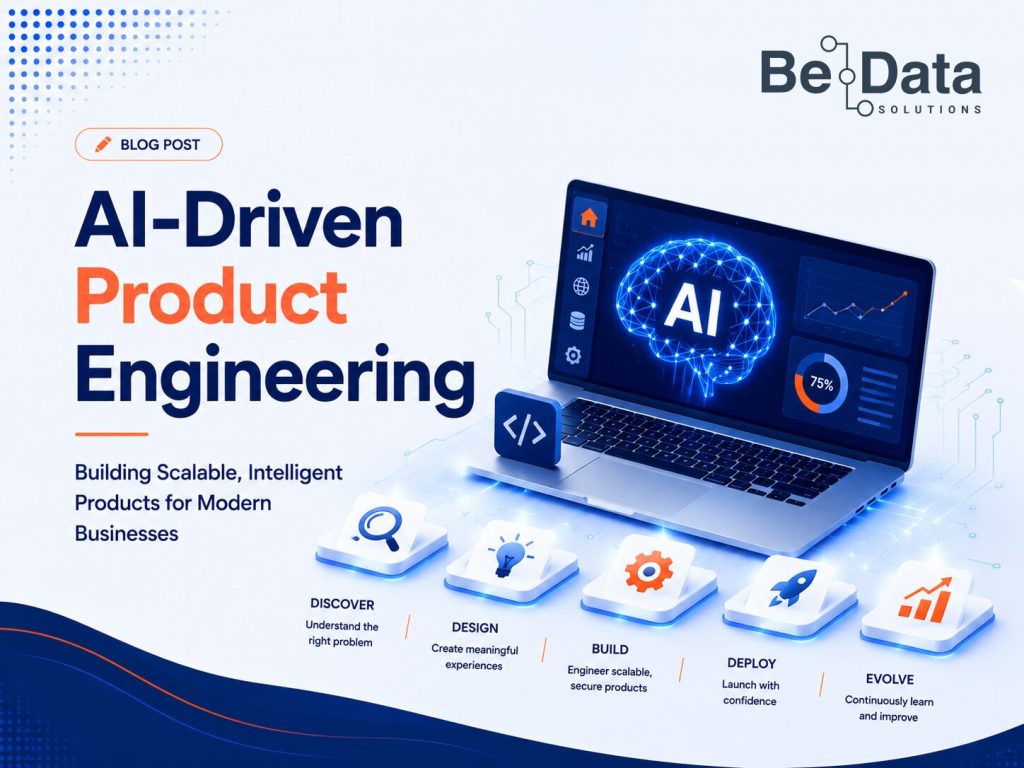
A successful product moves through a structured lifecycle. Each stage has a specific purpose.
Stage 1: Ideation and Problem Definition
This is where the business problem is clarified. Teams identify users, pain points, goals, constraints, and success criteria.
Important questions include:
- What problem are we solving?
- Who experiences this problem?
- How is the problem handled today?
- What is the cost of doing nothing?
- What would a successful product change?
Skipping this stage often leads to products that are technically functional but commercially weak.
Stage 2: Requirements and Solution Design
Once the problem is clear, the team defines what the product should do and how it should work.
This includes:
- Functional requirements
- Non-functional requirements
- User roles and permissions
- Data requirements
- Architecture planning
- UX flows
- Integration requirements
- Security considerations
- MVP scope
This stage creates alignment between business stakeholders, product teams, designers, and engineers.
Stage 3: Prototyping and MVP Development
The product is then developed in short, iterative cycles. The goal is to build a usable version quickly, test assumptions, and gather feedback.
For startups, this may mean an MVP.
For enterprises, it may mean a pilot or internal release.
For SaaS businesses, it may mean a new module or feature set.
A good MVP is not a poor-quality product. It is a focused product that proves the most important assumptions first.
Stage 4: Testing and Validation
Before launch, the product must be tested from both technical and business perspectives.
Validation should answer:
- Does the product work correctly?
- Is it secure?
- Is it fast enough?
- Is the user experience clear?
- Does it solve the intended problem?
- Are the data outputs accurate?
- Can it support real users?
- Are key workflows covered?
This stage reduces risk before the product reaches a wider audience.
Stage 5: Deployment and Launch
Modern product launches are controlled and measurable. Instead of treating launch as a one-time event, product engineering teams use staged rollouts, monitoring, and feedback loops.
Launch activities may include:
- Production deployment
- Release planning
- User onboarding
- Documentation
- Monitoring setup
- Performance checks
- Feedback collection
- Incident response planning
A successful launch is not just about going live. It is about making sure users can get value quickly.
Stage 6: Continuous Improvement and Modernisation
The product does not stop after launch. Real product value is created through continuous improvement.
Post-launch activities include:
- Monitoring performance
- Analysing user behaviour
- Fixing bugs
- Improving UX
- Adding features
- Optimising infrastructure
- Enhancing data quality
- Improving AI models
- Reducing technical debt
- Modernising legacy components
This is where product engineering becomes a long-term competitive advantage.
Product Engineering for Different Business Needs
Different organisations need product engineering for different reasons.
Product Engineering for Startups
Startups need speed, focus, and validation. The goal is to launch quickly, learn from real users, and avoid wasting budget on unnecessary features.
For startups, product engineering helps with:
- MVP development
- Rapid prototyping
- Technical architecture
- SaaS platform development
- Investor-ready product demos
- Early analytics setup
- Scalable foundations for future growth
The priority is not perfection. The priority is learning fast with a product that is stable enough to test in the market.
Product Engineering for Scale-Ups
Scale-ups often have a working product but need to improve architecture, performance, automation, or data visibility.
Product engineering can help scale-ups with:
- Platform modernisation
- Performance optimisation
- Product analytics
- Cloud migration
- API restructuring
- DevOps maturity
- Data platform development
- AI feature integration
- Security and compliance improvements
At this stage, the challenge is usually growing without creating technical debt that slows the business later.
Product Engineering for Enterprises
Enterprises often need to modernise legacy systems, integrate multiple platforms, improve reporting, and automate complex workflows.
Product engineering helps enterprises with:
- Legacy system modernisation
- Internal product development
- Data and analytics platforms
- Workflow automation
- Secure cloud architecture
- Compliance-aware engineering
- Enterprise integration
- AI-enabled decision support
The focus is reliability, governance, scalability, and measurable operational improvement.
Product Engineering for Data and AI Products
Data and AI products need a more specialised engineering approach. These products depend on data quality, model performance, governance, and user trust.
Examples include:
- AI search platforms
- Predictive analytics tools
- BI dashboards
- Data portals
- Document intelligence systems
- Recommendation engines
- Natural language analytics tools
- Automation platforms
For these products, software engineering and data engineering must work together from the start.
Key Technologies Used in Modern Product Engineering
Technology choices should support the product goal, not follow trends blindly. A strong product engineering stack is practical, maintainable, and aligned with the team’s capabilities.
Common technology areas include:
Frontend Engineering
- React
- Next.js
- Vue
- Angular
- Tailwind CSS
- Component libraries and design systems
Backend Engineering
- Node.js
- Python
- Django
- FastAPI
- Java Spring Boot
- .NET
- REST and GraphQL APIs
Databases
- PostgreSQL
- MySQL
- MongoDB
- SQL Server
- Cloud data warehouses
- Vector databases for AI search
Cloud and Infrastructure
- AWS
- Microsoft Azure
- Google Cloud
- Docker
- Kubernetes
- Serverless platforms
- CI/CD pipelines
Data and Analytics
- Data warehouses
- ETL/ELT pipelines
- BI dashboards
- Data quality frameworks
- Real-time data processing
- Product analytics tools
AI and Machine Learning
- Machine learning models
- Generative AI APIs
- NLP models
- Retrieval-augmented generation
- Vector search
- Model monitoring
- Responsible AI controls
The right stack depends on the product, team, budget, compliance needs, and long-term roadmap.
Common Product Engineering Mistakes
Many product initiatives fail because of avoidable mistakes. The most common ones include:
1. Building Without Clear Business Outcomes
If the team cannot define what success looks like, the product will become a collection of features instead of a business solution.
Every product should have measurable goals, such as reducing manual work, improving conversion, increasing retention, improving reporting speed, or reducing operational cost.
2. Over-Engineering Too Early
Building for massive scale before validating the product can waste time and budget. Early-stage products need strong foundations, but they do not need unnecessary architectural complexity.
The best approach is to design for evolution, not overbuild from day one.
3. Treating UX as Decoration
UX is not only about colours and layout. It affects how quickly users understand the product, complete tasks, and trust the system.
Poor UX can make even a technically strong product fail.
4. Ignoring Data Quality
AI, analytics, and automation depend on reliable data. If the product is built on poor data foundations, the outputs will be inconsistent and users will lose confidence.
Data quality should be designed into the product from the beginning.
5. Weak Testing and Monitoring
A product that is not tested properly becomes expensive to maintain. A product that is not monitored properly creates a hidden risk.
Testing and observability are essential for long-term reliability.
6. Separating Product, Engineering and Data Teams
When teams work in silos, important context gets lost. Product engineering works best when strategy, design, software, data, and QA collaborate continuously.
Cross-functional ownership leads to better decisions and stronger outcomes.
How to Measure Product Engineering Success
Product engineering success should be measured across both technical performance and business impact.
Engineering Metrics
- Deployment frequency
- Cycle time
- Change failure rate
- Mean time to recovery
- System uptime
- Error rate
- Test coverage
- API response time
- Infrastructure cost efficiency
Product Metrics
- User adoption
- Feature usage
- Retention
- Churn
- Activation rate
- Time-to-value
- Customer satisfaction
- Task completion rate
Business Metrics
- Revenue impact
- Cost reduction
- Productivity improvement
- Decision-making speed
- Operational efficiency
- Customer lifetime value
- Reduced manual effort
The best product teams connect engineering metrics with business metrics. Faster releases only matter if they help the product deliver more value.
The Future of Product Engineering
Product engineering is moving toward more intelligent, automated, and data-driven delivery models.
The biggest trends include:
AI-Native Product Development
AI will increasingly support code generation, testing, documentation, analytics, user support, and product personalisation. But successful teams will use AI with governance, human oversight, and clear business goals.
Data-Driven Product Decisions
Product decisions will rely more on telemetry, analytics, user behaviour, and experimentation. Teams will build based on evidence, not assumptions.
Embedded Analytics and Intelligent Interfaces
More products will include built-in dashboards, natural language search, recommendations, and predictive insights.
Cloud-Native and Modular Architecture
Businesses will continue moving toward scalable cloud platforms, modular systems, API-first architecture, and automation-led delivery.
Responsible AI and Governance
As AI becomes embedded in business products, organisations will need stronger controls around security, transparency, fairness, compliance, and monitoring.
Continuous Modernisation
Products will no longer be rebuilt every few years. Instead, they will be continuously improved, refactored, and modernised as business needs change.
Why Choose Be Data Solutions for Product Engineering?
Be Data Solutions helps organisations design, build, modernise, and scale data-driven software products.
Our strength is the combination of software engineering, data engineering, analytics, and ML & AI capability. This allows us to build products that are not only functional but intelligent, measurable, and ready for long-term growth.
We support businesses across sectors including retail, healthcare, media, manufacturing, professional services, public sector, real estate, and non-profit organisations.
Our product engineering approach focuses on:
- Clear business outcomes
- Strong technical architecture
- User-centred design
- Secure and scalable development
- Reliable data foundations
- Practical AI integration
- Continuous delivery
- Measurable product improvement
Whether you are building a new SaaS platform, modernising an existing system, creating a data product, or embedding AI into business workflows, Be Data Solutions can help you move from idea to production with confidence.
Conclusion
Product engineering is now one of the most important capabilities for businesses that want to build better digital products.
It combines software, data, design, cloud, testing, and AI into a continuous process of product improvement. Instead of simply delivering features, product engineering focuses on solving real problems, creating measurable value, and helping products evolve with users and markets.
The companies that succeed will not be the ones that build the most software. They will be the ones who build the right products, measure what matters, and improve continuously.
If your organisation is planning a software, data, or AI product initiative, Be Data Solutions can help you design, build, and scale it with the right engineering foundation.
FAQs
What is product engineering?
Product engineering is the end-to-end process of designing, building, testing, launching, and continuously improving a digital product. It combines software engineering, product strategy, UX, data, cloud, QA, and post-launch optimisation.
How is product engineering different from software development?
Software development usually focuses on building specific features or systems. Product engineering focuses on the full product lifecycle, including problem discovery, user experience, architecture, data, testing, launch, measurement, and continuous improvement.
What are product engineering services?
Product engineering services include product discovery, UI/UX design, software development, data engineering, cloud architecture, DevOps, QA, analytics, AI integration, and ongoing product modernisation.
Why is data important in product engineering?
Data helps teams understand users, measure performance, improve decision-making, power analytics, and enable AI features. Without reliable data foundations, products become harder to scale and improve.
What is AI product engineering?
AI product engineering is the process of embedding AI capabilities into digital products in a practical, secure, and measurable way. This may include intelligent search, predictive analytics, automation, AI copilots, NLP, recommendations, and generative AI features.
When should a business use a product engineering partner?
A business should consider a product engineering partner when it needs to build faster, access specialist skills, modernise legacy systems, integrate data and AI, improve delivery capacity, or reduce technical risk.
What makes Be Data Solutions different?
Be Data Solutions combines software engineering, data engineering, analytics, and ML & AI expertise. This makes us well-suited for businesses that need intelligent, data-driven products rather than standalone software systems.