
Offshore Delivery Should Not Mean Offshore Accountability
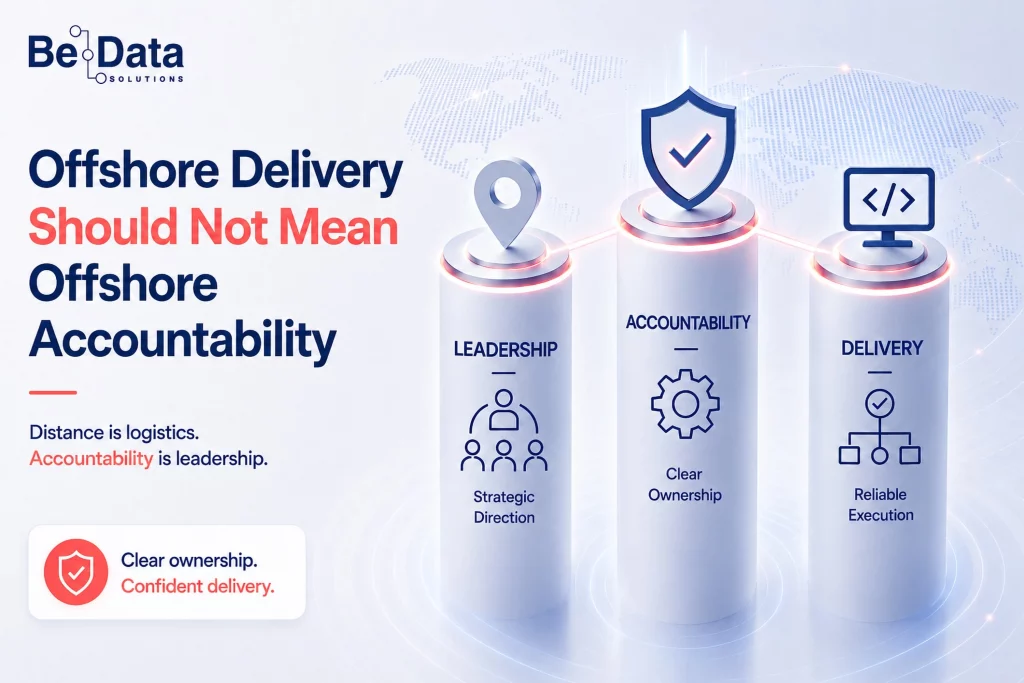
Every technology buyer we’ve spoken to about offshore delivery eventually asks some version of the same question: how do we know this will actually work when the team is thousands of miles away? It’s a fair question, but after years of building and running distributed engineering teams, we’ve come to think it’s the wrong one. The problems we’ve seen kill offshore engagements almost never trace back to distance. They trace back to nobody having written down, clearly, who is accountable for what. That’s the argument this article is going to make, and it’s also more or less how we’ve built our own delivery model.
Distance was never really the issue
We’ve watched delivery go badly wrong between a client in London and a supplier also based in London, because nobody had actually decided who owned architecture decisions. And we’ve watched delivery work extremely well across a six-hour time difference, simply because ownership, escalation and reporting had been thought through properly before the work started.
Distance is a logistics problem. Calendars, overlap hours, decent tooling – all of that is genuinely easier to solve now than it was even five years ago. Unclear accountability is a different kind of problem entirely, and proximity doesn’t fix it. Neither, frankly, does hiring brilliant engineers. A talented developer who doesn’t know who’s supposed to sign off on an architectural decision, or who’s responsible when a deadline slips, will eventually produce the same result as a mediocre one: drift, rework, and a client who’s stopped trusting the relationship.
So here’s the position we’d defend to anyone: the primary risk in distributed delivery is not distance. It’s unclear ownership. A good delivery model isn’t defined by where the engineers happen to sit. It’s defined by what stays accountable locally, what genuinely belongs to the delivery centre, and whether the two sides are actually connected by something more durable than good intentions.
“The primary risk in distributed delivery is not distance. It’s unclear ownership.”
What has to stay accountable locally
Not everything should be pushed out to a delivery centre, no matter how capable the team is. Some things need to sit with people who are close to the client relationship and understand the wider context the client is operating in.
Architecture is the obvious one. Decisions about system design and long-term technical direction have consequences that outlast whatever ticket is currently in the sprint. Those decisions need to be made, or at the very least formally signed off, by senior architects who understand the client’s whole technology landscape – not just the piece of work directly in front of them. That doesn’t mean a delivery centre shouldn’t propose architecture. Good ones do, often, and their input deserves to be taken seriously. It just means someone accountable for the consequences two years down the line needs to be the one who says yes.
Commercial decisions are the same. When a client wants a straight answer on budget, timeline risk, or a trade-off in scope, they need one senior person who can actually commit to something – not a chain of people who each have to check with somebody else first. We’ve seen this go wrong more times than we can count: a simple commercial question gets passed along a relay of people, and by the time an answer comes back, the client has quietly lost confidence in the whole engagement, even if the answer itself was fine.
Relationship ownership follows the same pattern. Somebody needs to hold the full picture of what a client actually needs, including the bits that never show up in a ticket – the internal politics, the reason a particular date matters more than it looks like it should, what’s already been tried and failed before. That person needs to be senior enough, and present enough, to make calls without escalating every single thing.
And security and compliance shouldn’t be something a client has to take on faith is “handled somewhere in the chain.” There should be one named person accountable for it, ideally sitting under recognised standards like ISO/IEC 27001, who can actually answer questions about the organisation’s practices rather than pointing elsewhere.
What the delivery centre should actually own
None of the above is an argument against distributed delivery, and it’s definitely not a suggestion that a delivery centre exists purely to follow orders. A well-run one carries real ownership. It’s just ownership of a different kind.
Day-to-day execution belongs to the delivery centre – writing and reviewing code, building and testing features, keeping engineering standards up, and flagging problems early rather than waiting to be asked whether anything’s wrong. The best delivery teams we’ve worked with don’t simply implement whatever they’re told. They push back on unclear requirements, raise technical debt before it becomes expensive, and bring their own expertise to problems the client hasn’t fully thought through yet.
Day-to-day quality sits there too – code review discipline, automated testing, holding the line on standards that were agreed together rather than handed down. A delivery centre with genuine ownership of quality catches issues before they reach a client demo, not after someone’s already asking awkward questions in a meeting.
More and more, strong delivery centres also carry specialist depth that a client organisation simply doesn’t have in-house: modern data engineering practice, MLOps, particular cloud platforms, current AI implementation patterns. Honestly, this is often the real commercial case for a distributed model in the first place – not just lower cost, but access to concentrated skill that would take a long time and a lot of money to build internally.
What shouldn’t sit with the delivery centre, without someone locally signing off, is anything that shifts the client’s technical direction, commercial exposure, or risk appetite. It’s not about whether the delivery centre is capable. It’s about which decisions need a second set of accountable eyes before they become difficult to undo.
Laid out side by side, the split looks like this:
| Stays Accountable Locally | Owned by the Delivery Centre |
|---|---|
| Final sign-off on architecture and technical direction | Day-to-day execution — building, testing, shipping |
| Commercial decisions — budget, timeline, scope | Code review discipline and quality mechanics |
| The overall client relationship and business context | Specialist technical depth (data engineering, MLOps, AI implementation) |
| Security and compliance accountability | Surfacing technical risk and pushing back on unclear requirements |
Not because the delivery centre isn’t trusted with the rest. It’s simply that these are the decisions that are hard to undo once they’re made, and they need someone accountable for what happens after.
Governing architecture without slowing everything down
Architecture is usually where accountability gets blurry first in distributed delivery, and it’s the most expensive place to get wrong, because architectural mistakes are painful to unwind once they’ve been built on top of.
What tends to work is fairly simple. A named senior architect, based with the client-facing leadership, holds formal accountability for architecture across the engagement. That doesn’t mean every decision funnels through one overloaded person – it means every significant decision has a clear point of accountability, even if the proposal originated somewhere else entirely.
Decisions above a certain threshold go through a lightweight review – not a rubber stamp, but not a six-week committee either. A short written record of what was decided, why, what else was considered, and who signed it off. It sounds like a small thing. In practice it prevents an enormous amount of the confusion that quietly erodes trust months later, when nobody can quite remember why a technical choice was made the way it was.
And engineers in the delivery centre should be part of these conversations, not kept at a polite distance from them. People building a system every day often see constraints and possibilities that leadership, one step removed, simply won’t spot. Treating the delivery centre as a source of architectural insight, rather than just an executor of decisions made somewhere else, tends to produce better decisions and fewer surprises.
Getting the communication rhythm right
Distributed delivery rarely fails because people live in different countries. It fails when communication is left to chance – when the only update is whatever someone happens to remember to send, and the first the client hears about a problem is once it’s already a real problem.
A working rhythm has a small number of fixed points rather than a long list of optional ones that quietly stop happening under pressure.
| Cadence | Who’s Involved | What It Covers |
|---|---|---|
| Daily / near-daily sync | Engineering team | Keeps technical work visible, unblocks day-to-day issues |
| Weekly checkpoint | Client-facing leadership | Progress against plan, emerging risk, decisions needed |
| Monthly / milestone review | Senior leadership on both sides | Steps back to check the engagement is still pointing the right way |
That last one is the easiest to skip when everything feels fine, and it matters most for exactly that reason.
Underneath all of that, reporting needs to be honestly built, not just honestly intended. A status update that only ever says “on track” isn’t reassuring, it’s a warning sign. A well-structured engagement makes it easy – procedurally easy, not just theoretically possible – to say “this is behind, here’s why, here’s what we’re doing about it.” The alternative, where bad news has to fight its way up through people who’d rather not be the one delivering it, is how small problems turn into large ones.
Quality assurance needs the same clarity
Quality assurance in a distributed model needs exactly the same clarity as architecture, for the same reason – when it’s ambiguous, it doesn’t show up as a disagreement in a meeting, it shows up as a defect that’s already live.
In a well-run engagement, the delivery centre owns the mechanics: writing tests, running them, code review, holding the line on agreed standards. But client-facing leadership keeps responsibility for defining what quality actually means for this particular piece of work – which kinds of defect simply aren’t acceptable, how much test coverage genuinely matters versus what’s nice to have, what “done” actually looks like. Without that upstream clarity, a delivery team can execute perfectly against the wrong bar, and both sides end up frustrated over something that was entirely avoidable.
The engagements that handle this well treat the quality bar as something you revisit, not something you write once at kickoff and forget about. As a system matures and a client’s appetite for risk shifts, what counts as acceptable quality should shift too – deliberately, on purpose, rather than drifting somewhere nobody quite chose.
Escalating risk before it becomes a crisis
Every distributed engagement runs into risk sooner or later – a dependency nobody flagged, a technical constraint that wasn’t obvious at the start, a scope question that catches everyone off guard. What separates a well-run engagement from a badly run one usually isn’t whether risk shows up. It’s whether there’s a fast, easy path for it to reach someone who can actually do something about it.
That means a defined, short window between spotting a risk and it landing on the desk of someone with authority. It means people at any level of the team feel able to raise something without it looking like they’ve failed or stepped out of line. And it means whatever gets escalated actually gets closed out, with a visible owner, rather than sitting in a channel nobody ever looks at again.
| Risk Level | Response Window | Who Gets Involved |
|---|---|---|
| Minor — a local delay or small blocker | Same-day, handled within the team | Engineering lead |
| Significant — could affect scope, timeline, or cost | Within hours | Client-facing leadership |
| Critical — threatens delivery or the relationship | Immediate | Senior leadership on both sides |
Most of the distributed engagements we’ve seen deteriorate weren’t cases where nobody noticed the risk. Almost always, somebody had spotted it, often quite early. There just wasn’t a safe, quick way for them to get it in front of someone who could act.
Staff continuity matters more than most buyers expect
One risk we think gets consistently underweighted by technology buyers evaluating offshore models is turnover, and the loss of knowledge that comes with it.
A distributed delivery model is only as strong as its continuity. Losing a senior engineer three months into a complicated piece of work is expensive anywhere, but it’s particularly expensive when everything they knew about client context, past decisions, and undocumented quirks of the system leaves with them. This is really a governance question dressed up as an HR one – does the model have proper onboarding, documented decisions, and enough overlap between people that no single departure creates a hole? Or does critical knowledge live in one person’s head, with no plan for what happens if they move on?
The teams that handle this well build documentation and knowledge sharing into the normal working rhythm from the start, not as a scramble once someone’s already handed in their notice. They also build in enough depth on the team that losing one person doesn’t put a client’s work at risk. That’s a deliberate choice, not luck.
How our own UK–Bangladesh model works
We built our delivery model around exactly the principle this article has been making – where the work happens matters far less than who’s accountable for it.
Be Data Solutions is headquartered in London, with an engineering hub in Dhaka. Senior technical leadership, solution architecture, and commercial accountability sit with our UK team. Architecture decisions are led and formally signed off by UK-based senior architects working directly with clients, so the decision-maker actually understands the business context, not just the technical brief. Commercial ownership – budget, timeline, scope – sits with one accountable person who doesn’t need to check with someone else before answering a straightforward question.
Our Dhaka team carries real, substantial ownership of the technical work: data engineering, software development, quality assurance, and increasingly applied ML and AI implementation. It’s not a low-cost execution layer working off a spec handed down with no context. Our engineers there are part of architectural discussions, expected to push back where something doesn’t make sense, and given enough client context to make good day-to-day calls on their own rather than working purely to instruction.
We keep fixed communication rhythms across every engagement – daily engineering syncs, a weekly client checkpoint with UK leadership, and milestone reviews that step back from execution to check the direction is still right. Escalation is explicit and quick: anyone, at any level, has a clear route to flag a risk to someone who can act on it, and we treat how fast that happens as a genuine measure of how well an engagement is running, not an inconvenience to be tidied away.
We’re ISO/IEC 27001 certified for information security and ISO/IEC 42001 certified for AI management, with accountability for both held centrally by UK leadership rather than spread informally across the delivery chain. And we’ve deliberately invested in continuity in Dhaka – structured onboarding, documented decisions, and enough depth on each team that one person leaving doesn’t put a client’s work at risk.
None of this is unusual as an idea. What we’ve found, working with clients across the UK and elsewhere, is that it’s surprisingly unusual in practice – and the gap between organisations that structure this properly and those that don’t shows up directly in how reliable delivery actually is, far more than it shows up in engineer skill.
The question worth asking a delivery partner
If you’re evaluating an offshore or distributed partner, “where’s your team based?” is rarely the useful question. A better one is whether they can answer this, clearly and specifically, rather than with a vague reassurance that it’s “well managed”:
Five questions worth asking before you sign
- Who, by name and role, signs off on architecture decisions?
- Who has the commercial authority to make a binding call on budget or scope?
- What’s the actual time window between a risk being spotted and it reaching someone who can act?
- How is quality defined for this engagement, and who owns that definition?
- What happens to this engagement if a senior engineer leaves next month?
Partners who can walk you through real answers to those five, rather than a general assurance that everything’s under control, are the ones worth trusting with distributed delivery. The location was never really the thing to worry about.
Learn how Be Data structures international technology engagements — get in touch with our team →