
Why SaaS Mobile Applications Are Becoming Essential for Scalable Digital Products
Businesses are moving away from heavy, traditional software and choosing digital products that are easier to access, update, and scale. SaaS mobile applications support this shift by combining the flexibility of cloud-based software with the convenience of mobile access.
For growing organisations, this model offers a practical way to deliver services to customers, employees, and partners without depending on complex local installations or large upfront infrastructure. The result is faster delivery, better user engagement, and a product that can improve continuously over time.
What Are SaaS Mobile Applications?
A SaaS mobile application is a cloud-hosted software product designed for smartphones and tablets. Instead of buying and installing software on a specific device, users subscribe to the service, log in, and access the functionality through a mobile app or connected platform.
Popular SaaS products such as collaboration tools, cloud storage platforms, video meeting apps, CRM systems, and payment platforms follow this model. The core service runs in the cloud, while the mobile experience gives users quick access from anywhere.
Compared with standard web-based SaaS, mobile SaaS focuses more strongly on small-screen usability, push notifications, quick loading, secure authentication, and sometimes offline support. These details are important because mobile users expect speed, simplicity, and reliability.
SaaS Mobile Applications vs Traditional Software
The biggest difference is ownership and maintenance. Traditional software is usually installed on a device and updated manually. A SaaS mobile application is centrally hosted, continuously maintained, and accessed through a subscription model.
| Area | SaaS Mobile Application | Traditional Software |
|---|---|---|
| Installation | Accessible through cloud and mobile login. | Usually requires installation on each device. |
| Updates | Managed centrally and released regularly. | Often requires manual patches or version upgrades. |
| Cost model | Subscription-based with flexible user plans. | Often licence-based with higher upfront cost. |
| Scalability | Users, features, and resources can be scaled more easily. | Scaling may require more hardware, licences, or IT effort. |
| Accessibility | Available across devices when connected securely. | Often tied to a specific device or local environment. |
| Security | Centralised controls, monitoring, and compliance can be built in. | Security depends more on local devices and user-managed updates. |
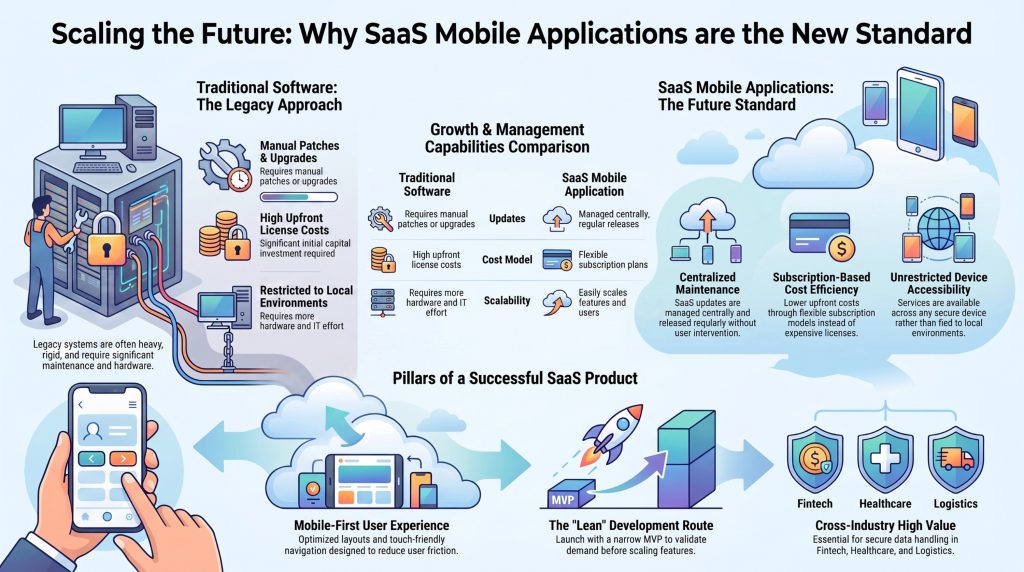
This is why SaaS is attractive for organisations with distributed teams, large user bases, or fast-changing product requirements. A business can start small, validate demand, and scale the product as usage grows.
Key Features of a Successful SaaS Mobile Application
A successful SaaS mobile product is not only a mobile interface connected to a cloud system. It needs the right mix of usability, architecture, security, and ongoing product support.
- Mobile-first user experience: Clear layouts, fast screens, simple navigation, and touch-friendly interactions help users complete tasks without friction.
- Scalable cloud infrastructure: The platform should handle growth in users, transactions, and data without performance issues or avoidable downtime.
- Secure access and data protection: Role-based access, encryption, audit trails, and compliance-ready controls are important when the product handles sensitive data.
- Custom workflows and integrations: SaaS products often need to connect with CRM, ERP, payment, analytics, communication, or reporting systems.
- Smooth onboarding: Simple registration, helpful guidance, and sensible defaults help new users understand the value of the product quickly.
- Continuous improvement: SaaS products should evolve through regular updates, performance optimisation, bug fixes, and new features based on user feedback.
The Role of AI-Assisted and Low-Code Development
Modern SaaS development is also becoming faster because of AI-assisted coding, low-code tools, reusable cloud services, and rapid prototyping platforms. These tools can help teams test ideas earlier, build MVPs faster, and reduce repetitive development work.
However, speed should not replace engineering discipline. A prototype can prove the concept, but a production SaaS mobile application still needs secure architecture, reliable data handling, observability, testing, and long-term maintainability.
For startups and innovation teams, the best approach is often to begin with a focused MVP, validate it with real users, then strengthen the platform as the product grows. This reduces waste while keeping the product ready for future scale.
Can a Small Team or Solo Developer Build a SaaS App?
Yes, a small team or even a solo developer can build an early SaaS product today. Cloud platforms, managed databases, authentication services, payment providers, and automation tools have made it easier to launch without building every component from scratch.
The challenge is that a real SaaS product involves more than code. It requires product planning, user experience design, secure infrastructure, billing, monitoring, customer support, and ongoing maintenance. This is where many early products struggle as they move from MVP to production.
A practical route is to keep the first version narrow, solve one clear user problem, measure adoption, and then expand features step by step. This approach helps teams avoid overbuilding and focus investment where it creates measurable value.
Where SaaS Mobile Applications Create Value
SaaS mobile applications can support many industries because they combine accessibility with scalable delivery. Common use cases include:
- Finance and fintech platforms for payments, customer onboarding, lending, reporting, and fraud monitoring.
- Healthcare systems for appointment management, patient communication, secure records access, and operational workflows.
- Education platforms for learning management, virtual classrooms, progress tracking, and student engagement.
- Retail and e-commerce tools for order management, inventory visibility, customer engagement, and loyalty programmes.
- Manufacturing and logistics applications for field operations, asset tracking, workflow approvals, and real-time reporting.
In each case, the value comes from making software easier to access, easier to improve, and easier to scale across users and locations.
How to Choose the Right SaaS App Development Partner
Building a SaaS mobile application requires more than attractive screens. The right development partner should understand product strategy, cloud architecture, mobile usability, security, data, analytics, and long-term support.
Before choosing a partner, organisations should check whether the team can design for scale, build secure integrations, support compliance needs, and create a user experience that people can adopt easily. The partner should also be able to guide product decisions, not only deliver tickets.
At Be Data Solutions, we combine software engineering, data engineering, analytics, and AI expertise to help organisations build practical, secure, and scalable digital products. Our focus is on systems that are production-ready, maintainable, and connected to real business outcomes.
Conclusion
SaaS mobile applications are becoming a strong foundation for modern digital products. They reduce the limitations of traditional software, support faster updates, improve accessibility, and give businesses a flexible way to scale as demand grows.
As AI, cloud platforms, and product engineering practices continue to mature, SaaS mobile applications will become even more important for organisations that want to launch faster and operate smarter. The businesses that invest in secure, scalable, and user-friendly SaaS products today will be better prepared for tomorrow’s digital expectations.
Planning a SaaS mobile application? Be Data Solutions can help you plan, design, build, and scale secure digital products that support measurable business value.