Staff Augmentation Best Practices: How to Scale Your Tech Team Without Losing Control
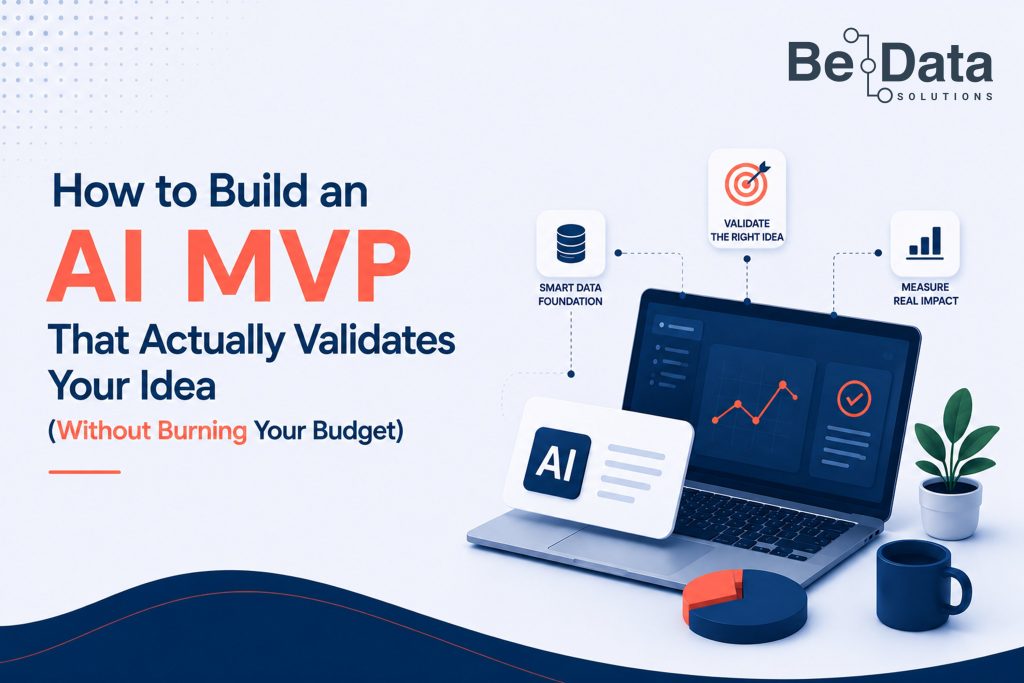
Most AI products fail not because the technology was wrong — but because the validation process was. Founders build confidently, spend heavily, and only discover the real problem once real users get involved. An AI MVP exists to prevent exactly that. But only if you build it the right way.
What Makes an AI MVP Different From a Standard MVP
The minimum viable product concept is well established — ship something lean, get it in front of users, learn fast. The principle holds for AI. The execution is fundamentally different.
With a conventional software MVP, you’re testing whether users want the functionality. With an AI MVP, you’re testing three things simultaneously:
- Does the user actually want the outcome the AI delivers?
- Is the data good enough to power a model that delivers it?
- Does the model perform reliably under real-world conditions — not just in testing?
That third layer is where most AI products break down. A model that performs cleanly against your internal benchmarks can behave very differently once real users interact with it in unpredictable, messy, real-world ways. AI is not deterministic the way conventional software is. Its quality is a direct function of data quality — and data quality is almost always messier than teams expect.
An AI MVP surfaces these problems early. While fixing them is still affordable.
The Scope Problem Most Teams Get Wrong
Before a single line of code is written, scope definition is where AI MVPs are won or lost. Most teams rush it.
Before development starts, get clear answers to these questions:
- What is the precise, specific problem this AI is solving — not the general domain, but the exact problem?
- What does the user experience look like at the exact moment the AI delivers value?
- What data currently exists, and is it genuinely representative of real-world scenarios?
- What does good performance look like in terms a non-technical stakeholder can evaluate?
One discipline worth enforcing: define success criteria before you build, not after. If you can’t articulate what a validated MVP looks like before launch, you won’t be able to evaluate results objectively once you have them.
Data First. Everything Else Is Secondary.
This is the single principle that separates teams who build AI products well from teams who struggle.
In conventional software, the system’s core logic lives in the code. In AI, the core logic lives in the model — and the model is only as good as the data it was trained on. That changes the entire development sequence.
What this means in practice:
- Audit your data before anything else. What exists? Where does it live? How was it collected? How clean is it? How representative of real-world scenarios is it? Honest answers here shape every decision that follows.
- Build your data pipeline production-ready from day one. Teams that treat data infrastructure as something to clean up after the model is built consistently produce fragile systems. Getting the pipeline right early is slower upfront and significantly faster overall.
Plan for continuous data collection post-launch. The version of your model that launches is not the version users will experience in six months. That’s not a problem — it’s the design.
AI MVP Development: Phase-by-Phase Breakdown
| Phase | Key Activities | What Can Go Wrong If Skipped |
| 1. Define Scope & Success Metrics | Clarify exact use case, target user, and measurable success criteria | Building the right tech for the wrong problem |
| 2. Data Audit & Pipeline Build | Assess existing data, identify gaps, build production-ready pipeline | Model fails in real-world conditions due to poor training data |
| 3. Model Development | Select architecture, train initial model, establish performance benchmarks | Overfit models that work in testing, break in production |
| 4. Integration & Testing | Connect model to product UI, run QA across real user inputs | Technical debt that compounds quickly at scale |
| 5. MVP Launch | Deploy to a controlled user group, activate analytics immediately | No baseline data to measure improvement against |
| 6. Monitor, Retrain & Iterate | Track model performance, collect feedback, schedule retraining cycles | Performance degrades silently, users churn before the team notices |
Build In-House or Partner? An Honest Assessment
The build-versus-partner question comes up in every AI MVP conversation. The honest answer depends on two things: what your team actually knows, and how much runway you have left to find out.
AI product development requires a specific combination of skills — data science, ML engineering, MLOps, and the experience of building AI systems that perform in production, not just in demos. Assembling that combination in-house takes months. Every month spent hiring and onboarding is a month of runway consumed before a single user validates anything.
For most startups and growing organisations, the calculus is clear: working with a partner who already has that expertise compresses the validation timeline significantly. The key is choosing a partner who treats your project as a real product problem — not a billable delivery exercise.
Why Startups Choose Be Data Solutions for AI MVP Development
There’s no shortage of AI development shops. What’s rarer is a partner with genuine technical depth, honest commercial conversations, and a track record of shipping AI products that perform beyond the demo stage.
Here’s why organisations building AI MVPs choose to work with Be Data Solutions:
- Senior-led delivery. Every engagement is led by experienced UK-based technical specialists — not handed off to junior teams after the sale. The people you speak to are the people building your product.
- Full-stack AI expertise. Our team covers the complete AI product stack: data engineering, ML model development, MLOps, cloud infrastructure, and software engineering. No gaps. No subcontracting the parts we don’t know.
- Data-first methodology. We begin every AI engagement with a thorough data audit — because the quality of your AI is a direct function of the quality of your data. We won’t skip this step, even when timelines are tight.
- Honest scope conversations. We push back on vague briefs. If your requirements aren’t clear enough to build against, we’ll tell you — and help you sharpen them before a single sprint begins.
- Flexible engagement models. Whether you need a complete AI MVP build, targeted specialist augmentation for an existing team, or a structured discovery engagement before committing to a full build — we structure engagements around what your situation actually requires.
- No overselling on AI capability. We’re direct about what AI can and cannot reliably deliver, what your data can currently support, and what realistic performance looks like at MVP stage versus at scale. You make better decisions with honest information.
What a Well-Structured AI MVP Actually Looks Like
Pull everything above together, and a well-structured AI MVP has these characteristics:
- Narrow scope. One problem. One user type. One core AI capability. Every feature not directly necessary to validate the central assumption has been cut.
- Production-quality data pipeline. Built to handle real-world inputs from day one, with a plan for continuous data collection after launch.
- Monitoring from the start. Model performance is visible in production — not just in testing. You can see what the AI handles well and where it struggles.
- A defined learning agenda. The team agrees on what specific questions the MVP is meant to answer before it launches. It’s a hypothesis test, not just a product release.
Thinking about building an AI MVP? Whether you’re at the idea stage or you’ve already built something that isn’t performing the way you expected, we’re happy to have a direct, no-pitch conversation about where things stand and what a smarter path forward looks like.
Get in touch with the Be Data Solutions team →