
Real-Time Data Analytics: When Does Your Business Really Need It?
Real-time data analytics can improve business decision-making, but only when teams are ready to act immediately. Learn how to match data velocity with decision velocity and avoid unnecessary live dashboard costs.
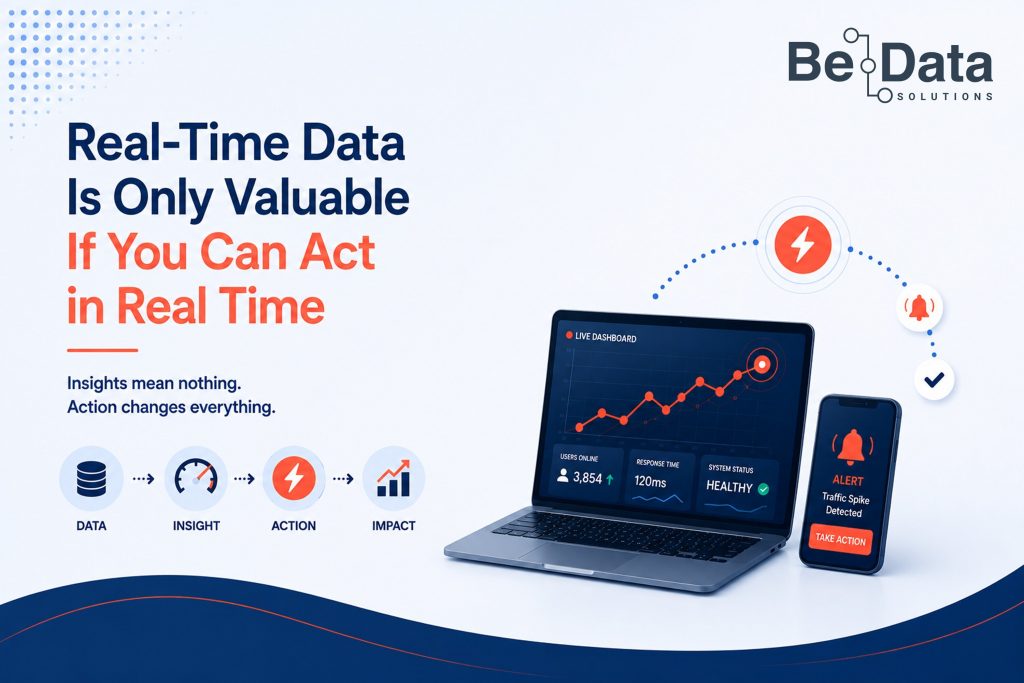
Real-Time Data Is Only Valuable If You Can Act in Real Time
Real-time data has become one of the most requested features in modern business systems. Many organisations want live dashboards, instant updates, and real-time analytics because they believe these tools will automatically make their business more data-driven.
But real-time data is only valuable when it supports real-time action.
A dashboard that updates every second may look impressive. However, if no one uses that information to make an immediate decision, the business may not be getting real value from it. In many cases, a clear daily report can be more useful, more practical, and more cost-effective than a complex live dashboard.
Why Businesses Ask for Real-Time Dashboards
Businesses usually want real-time dashboards because they want better visibility across operations. This can include:
- Sales performance
- Customer activity
- Stock movement
- Delivery status
- Service requests
- Production activity
- Financial transactions
- Team performance
- System health and downtime
The expectation is simple: if data is visible instantly, the business can respond faster.
That is true in some cases. But not every business decision needs to happen immediately. Before investing in real-time analytics, organisations need to understand whether the speed of the data actually matches the speed of decision-making.
The Key Question Before Building Real-Time Analytics
Before building a live dashboard, every business should ask one important question:
What decision will we make differently because we can see this data in real time instead of tomorrow morning?
If the answer is clear, real-time analytics may be valuable.
If the answer is unclear, the business may not need real-time analytics yet. It may simply need better daily reporting, better data quality, or a clearer dashboard structure.
Real-Time Data vs Daily Reporting
Real-time data and daily reporting are both useful, but they solve different business problems.
| Area | Real-Time Analytics | Daily Reporting |
| Purpose | Supports immediate action | Supports review, planning, and analysis |
| Data update frequency | Seconds or minutes | Daily, weekly, or scheduled |
| Best for | Urgent operational decisions | Management decisions and performance reviews |
| Cost | Usually higher | Usually lower |
| Complexity | More technical setup required | Easier to maintain |
| Example use case | Fraud alerts, delivery tracking, system monitoring | Sales reports, KPI summaries, monthly performance analysis |
The goal is not to make every report real time. The goal is to make data available at the right speed for the decision it supports.
Match Data Velocity with Decision Velocity
One of the most common mistakes in data analytics projects is focusing only on how fast data can be displayed.
But fast data does not automatically create fast decisions.
There are two important concepts to understand:
| Concept | Meaning |
| Data velocity | How quickly data is collected, processed, and shown |
| Decision velocity | How quickly the business can understand the data and take action |
If a dashboard updates every second, but the team only reviews it once a day, the business is not truly operating in real time. It is only paying for real-time infrastructure without using it properly.
This is why businesses should match their data velocity with their decision velocity.
When Real-Time Analytics Makes Sense
Real-time analytics can create strong business value when immediate action is required.
It is useful when:
- Delays can cause financial loss
- Customer experience can be affected immediately
- Operational issues need quick response
- Teams are actively monitoring the data
- Alerts trigger a clear action
- Automated systems can respond without waiting for manual review
- The business process depends on live information
Examples of Good Real-Time Analytics Use Cases
| Use Case | Why Real-Time Data Helps |
| Fraud detection | Suspicious activity needs immediate action |
| Delivery tracking | Delays can be handled before they affect customers |
| Inventory monitoring | Stock issues can be identified quickly |
| Customer support queues | High waiting times can be managed instantly |
| System monitoring | Downtime or errors need urgent response |
| Manufacturing operations | Production issues can be fixed before they grow |
| Financial transactions | Risk and compliance issues may need immediate alerts |
In these cases, real-time analytics is not just a visual feature. It becomes part of the business operation.
When Daily Reporting May Be the Better Option
Daily reporting may be more suitable when the business does not need immediate action.
It is often better when:
- Decisions are made during scheduled meetings
- Reports are used for management review
- The data is mainly used for trend analysis
- Users need simple and clear KPI summaries
- Real-time infrastructure would increase cost without improving outcomes
- The organisation does not have a team available to monitor live data
Examples Where Daily Reporting Is Often Enough
| Use Case | Better Reporting Option |
| Monthly sales performance | Daily or weekly sales report |
| Marketing campaign review | Scheduled campaign dashboard |
| Employee productivity review | Daily or weekly KPI summary |
| Financial performance review | Daily, weekly, or monthly finance report |
| Management reporting | Executive dashboard with scheduled updates |
| Long-term trend analysis | Historical reporting and business intelligence |
For many organisations, better daily reporting can deliver more value than a live dashboard. A simple report with accurate data, useful KPIs, and clear business context can help leaders make better decisions without unnecessary complexity.
Signs Your Business May Not Need Real-Time Analytics Yet
Your business may not need real-time analytics if:
- No one is responsible for monitoring the live dashboard
- The data does not trigger any immediate action
- Decisions are still made daily, weekly, or monthly
- The same outcome would happen even if the data was reviewed tomorrow
- The dashboard is mainly being requested because it looks modern
- The team does not have a clear process for responding to alerts
- The cost of real-time infrastructure is higher than the business value it creates
In this situation, the better investment may be a cleaner reporting structure, improved data accuracy, and better decision workflows.
Real-Time Analytics Should Not Become a Vanity Project
Real-time analytics is a capability. It should not become a vanity project.
A live dashboard that looks impressive but does not support business action is not a strong business intelligence solution. It is only a display.
Before building any analytics system, organisations should clearly define:
- Who will use the dashboard
- What decision they need to make
- How quickly that decision must happen
- What action will be taken from the data
- What business outcome the dashboard should improve
- Whether real-time data is truly required
The best dashboard is not always the one that updates the fastest. The best dashboard is the one that helps the business act with confidence.
Practical Checklist Before Building a Real-Time Dashboard
Use this checklist before investing in real-time analytics:
| Question | Why It Matters |
| What decision will this dashboard support? | Confirms the business purpose |
| Does the decision need to happen immediately? | Validates the need for real-time data |
| Who will monitor the dashboard? | Ensures ownership |
| What action will be taken when the data changes? | Connects insight to execution |
| What happens if the data is reviewed tomorrow instead? | Tests whether real-time is necessary |
| Is the data accurate and reliable? | Prevents fast but incorrect decisions |
| Can alerts or automation improve the process? | Increases operational value |
| Is the cost justified by the business impact? | Protects the investment |
If these questions cannot be answered clearly, the business may not be ready for real-time analytics.
Final Thoughts
Real-time data can transform business operations when it is connected to real-time action. But if the business cannot act immediately, real-time analytics may not be the right investment.
In many cases, better daily reporting, improved data quality, and clearer decision workflows can create more business value than a live dashboard.
The principle is simple:
Match your data velocity to your decision velocity.
At Be Data Solutions, we help organisations design practical data analytics, business intelligence, and reporting solutions that are aligned with real business decisions, not just dashboard visuals.